Showing posts with label national identity. Show all posts

Monday, March 26, 2012

National identity: sometimes all you need is good negotiations skills!

As you might recall from several earlier posts, one of the main questions I had at the begining of this multilingual journey was: who will my kids will cheer for at the Olympic games?! Which national identity will they choose? As a monolingual by birth, born and raised in one place, I had a hard time to project their vision of things, having their young lives already split between three countries. However, it did not take long to have a cristal clear vision of the situation: both Milo and Zeno have been spelling out that they feel French.
They cheer for France at international sports games, they always choose the French flag, when traveling they are proud to showcase their (supposed) nationality They have assimilated a total identification with their daily environment.  A few nights back we had again this conversation:

Milo: " Mum, I'm French, right?
Me: "You are not, my dear: you are half Italian and half Belgian!"
Milo: "Bullocks! I was born here!"
Me: "Yes, but from foreign parents. The law in France is different and you will be able to request the French nationality when you'll be 18, if you wish so.. for the moment it simply mean that you don't have a French passport."
Milo: "Yes I do!"
Me: "No, darling...you have exactly the same rights as any other French kid, but technically you are not French. You are...European!"
Milo: " Pffff...n'importe quoi!"
Zeno: " But....we ARE Parisians, right?!"

Zeno found a compromise and managed to snatch the Parisian badge for himself! That's so him!
He's also the one that, during a fantastic summer vacation on the Italian Alps, on a glorious, sunny afternoon, let himself fall backward on a heep of grass and whispered: "Aaah....I wish I was born here!"

Next on MTK: how the Belgianite and I are applying for an international school which has both the Italian and the Dutch sections and if accepted, we'll need to throw a coin!

Wednesday, March 31, 2010

Who you really are: a post about national, linguistic and cultural identity for multilinguals.

This post is meant as an entry for the Blogging Carnival on Bilingualism which I will be hosting on April 2nd.
Come back in a few days to check it out!


When our sons were born, we found ourselves having to deal with a complex linguistic situation, being both parents native speakers of different languages (Italian and Dutch), living in a third country (France) and communicating in a fourth language (English). After some research, we opted for the OPOL method, and, 6 years later, we can honestly say it has worked well for us. Although the Belgianite and I are both multilingual, it was natural for us to decide to use our respective native language with the kids.

However, what happens when the parents are bilingual from birth?

Consider Elena, a bilingual native Italian/French speaker: she is married to another bilingual native Spanish/English speaker. The couple resides in the UK. Their 6 months old daughter has all the chances of growing up quadri-lingual. Elena has opted for speaking Italian in the mornings and French in the afternoons, yet she wonders if it is going to really work.

I attended recently a conference of the Café Bilingue here in Paris, where Ranka Bijeljac-Babic, a CNRS researcher, specialized on bilingualism, shared some of the latest research projects on bilingual kids (I am writing a separate post on this conference). Several bilingual parents like Elena asked the same type of question: did they really have to choose one of their native languages? It is easy to relate and understand their resistance to this notion of having to choose. They grew up with 2 languages, each expresses a strong aspect of their personality and is linked to a cultural patrimony that these parents desire passing on. To choose between one or another is like asking them to get rid of one of their arms or legs!

However, specialists seem to be wary of one parent carelessly addressing the child in 2 (ore more) languages during the first 3 years, that is in the delicate phase when the language structure is building itself. The advantage of OPOL is that the child has a clear and well defined identification to a specific parent for each language. This schema provides the necessary linguistic boundaries so that each language can build itself consistently, progressively and separately.

But a careless OPTL (One Parent, Two Languages – note, I am making this up!) can be potentially harmful and lead to all sorts of problematic situations.
The fact that you are bilingual, Elena, is a richness, and you have all the due motivation (and right!) to pass on your cultural heritage, and to stay true to yourself. Moreover, since you probably speak French and Italian (and obviosuly English) on a daily basis, your child has already "heard" you while she was in uterus: research shows that 7 months into the pregnanacy the auditory system of the foetus is complete, hence your baby has grown accustomed to hear you speaking these different languages.

However, since your child is also confronted to 2 additional languages (Spanish from your husband and English from the environment), you have to consider the child and the potential difficulties she might have in dealing with such a complex linguistic arrangements. For bilingual/multilingual children, language acquisition is indeed more complex. The baby has to differentiate the languages (s)he hears, avoid interferences and learn that language is arbitrary.

Here in France pediatricians and speech therapists would strongly recommend you give up one of your 2 native languages. They have an expression I have heard several times, which I find irritating: "faire le deuil d'une de ses langues maternelles," that is, literally, mourning one of your mother tongues. I personally find this unnatural. I think your project is doable, but you need a well defined family language strategy, and loads of motivation, perseverance and patience. Think of the child: try to make things flow. You could, for instance, intensify the presence of other Italian and French speakers in your daughter’ routine. Ideally, you should find a care giver (a nanny, baby sitter) who would speak one of your 2 languages only, let’s say French, and you would only speak Italian. At least until the age of 3.

Alternatively, you can look into language play groups; on top of the different timings devoted to the 2 languages (Italian in the morning, French in the afternoon), you could also link each language to specific moments/activities/places: the bath, the playground, etc.

Finally, don’t be afraid to explain to your child from early on that you speak 2 languages, and why; to tell her your story, to show her on the map these 2 countries. Do not underestimate the meta-linguistic awareness of [multilingual] children!

I find Elena fascinating because she represents a preview of my children’s adulthood: when (if!) they will become parents themselves, they will be confronted with the same issue: will they want to speak Italian, Dutch or French to their kids? Unless their future partner will be a native speaker of any of these three, inevitably some of these languages (and a facet of their personality?) will be lost…

But even before getting to their future parenting issues, I have often wondered and written about their national, linguistic and cultural identity. And, alongside, dwelled on the notion of mother tongue: in Elena’s or my children’ case, we are obliged to use the term ‘mother tongues’:
"Mother tongue: the language a human being learns from birth.” [Language, by Leonard Bloomfield]
“Mother Tongue: the language that the speaker speaks best. In either case, a person's first language is a basis for sociolinguistic identity.” [The native speaker: myth and reality, by Alan Davie])
I have heard people claim: your mother tongue is the one you feel at ease counting in! Plausible: my mother tongue is Italian, I grew up monolingual and learnt languages as an adult. When it comes down to complex calculations (and mind, counting the rest from the baker for me qualifies as a complex calculation!), indeed, I have to resort to Italian. I still manage to do simple operations in English, but God forbid in French! On the other hand, I seem to have a hard time giving out my (French) phone number in English and Italian. But when I have to type in the pin code for my (French) credit card, it's definitely in Italian that I mentally recite the digits.

However, Milo (6) and Zeno (3 and ½) can both count easily in French, Italian and Dutch, so will the same ‘rule’ apply to them? Probably not. What language does Elena resort to for counting? I’d like to know!

“Your mother tongue language is the one you dream in!” I’ve also heard. Milo is a sleep talker and I have heard him on more than one occasion dreaming in French or Italian. Which makes sense!

Nav recently left in a previous post an intriguing related question: “Which language do you think on, when you are not conversing?” I started paying attention to my inner discussions, and I realized that the language varied with the environment or situation. At home it’s mostly Italian. On the way from school to work in the morning it’s French. But at work, or on the way home at night, it’s mostly in English. Basically, it depends upon the language I have been using actively moments earlier. Since I speak these three languages daily in both my personal and professional environment, I happen to think in all three as well.

There is another mother tongue indicator which is pretty infallible: anger! When I am truly upset, words pour out of me in Italian! Milo and Zeno as well, when they fight, it’s in Italian. Will it stay that way over time?

All in all, we, multilinguals and parents of multilingual children, "have to stop thinking that something more complex is necessarily less efficient," as a VP of a top French corporation recently oddly stated. With the rapidly changing demographics of our children' generation, so will change the way we define items like mother tongue and national identity.

Friday, January 22, 2010

The Italian brothers...

Zeno: "Mamma, mi canti 'L'Italia Tedesca' ?"
Me: "Cosa? Che canzone è?"
Milo: " Vuole dire la canzone dei Fratelli dell'Italia..."
Me: "Ah, Fratelli d'Italia...l'Italia s'è DES-TA, non tedesca!"
Zeno: "L'Italia sedesca!"
Milo (singing): "Frateeeeelliiii d'IIIIItaaaaaliaaaaa..."
Me & Zeno: "...l'Itaaaaliaaaaa s'è deeeestaaaaa...."

The dialogue above concerns the Italian national anthem, which I have sang to my children since they were babys on and off, on various occasions.  I learnt the national anthem as an adult, as it is not sang in schools, but rather at football games in stadiums (which, by the way, I never attended!). But since I moved abroad , to the US first and to France next, I became sensistive to this artistic symbol of my country: I find it a beautyful song (despite an occasional recurring debate in Italy concerning the need to swap it with some aria by Verdi or Puccini), and its choppy-rythm version has served several times as a perfect diversion from a tantrum or a difficult situation with my 2 little princes! Moral of the story, they learnt it too, over time,  and they enjoy it just like any other song, although, due to it's aulic Italian (it was written in 1846 by Goffredo Mameli) they don't understand all the lyrics and I always get the odd question ("Chi è Scipio? Perchè Roma aveva una schiava? Chi era la Schiava? Perchè sono pronti a morire?"). I think on some level they think the song is about them, since it talks about Italian brothers! They feel concerned!
While the identification with the French culture and its symbolysm has inevitably begun (Milo's drawings of boats and airplains always showcase a French flag), my two boys also identify strongly with their Italian side. A few weeks ago Zeno was watching a DVD cartoon in French, and after a while he asked me to switch it to Italian, "...perché noi siamo Italiani!"
Also, last weekend in Milan upon landing at the airport, he marveled at the fact that everyone spoke Italian! ("Mamma, ma parlano tutti Italiano qui!").
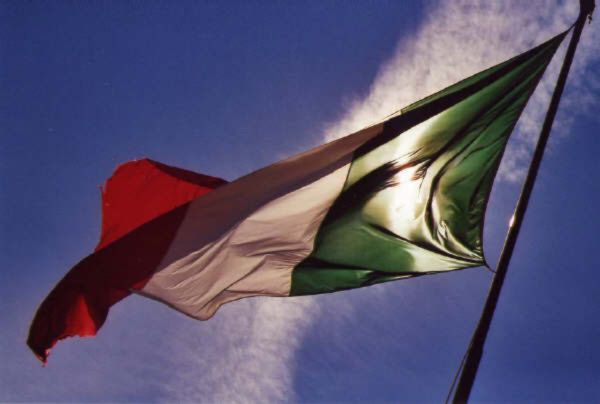
They are very aware of their Belgian identity as well, we have both flags in their room, they can spot Italy and Belgium on the map,  and they know that they are italo-belgian, but the Belgianite being less fanatic of anthems and symbols, the most Belgian behaviour they have assimilated so far is the addiction to quality chocolate!
I wrote recently on the public debate on National Identity that has taken (dangerously as well as corageously) place in France in the last few months, and one of the measures that came out of this debate is to make mandatory the regular singing of the French national anthem ('La Marseillese') in public schools. So, I guess that's the next song they will learn.
I still have a hard time, though, projecting the way they will feel once grown up, in terms of national identity. Will the amount of time we will have spent in France be a key factor? Will this early identification with Italy  provide a strong root? Will they have the TCK syndrome, at ease everywhere and nowhere at the same time?
I guess, for the time being, the best I can do is teach them also the European anthem, the beautiful 'Ode to joy' (Beehtoven's 9th Synphony) . I'll choose the Latin lyrics, though!

Wednesday, November 04, 2009

The debate online

For those of you francophones interested in the subject, here's the official website of the
French Debate on National Identity.

Wednesday, October 28, 2009

National Identity debate


French Immigration minister Eric Besson has declared on Sunday that he will re-launch a nation-wide debate for the next couple of months on national identity. He wants to re-assess and re-define 'what does it mean today to be French, what are the values that unify the French people, what is the nature of the link which makes them French and that they should be proud of.' (Good luck!).
The theme of national identity was a pillar of  Nicolas Sarkozy' electoral campaign, and keeps on re-emerging throughout his mandate. Immigration has profoundly affected the French society in the last 40 years. In 2003, after having doubled in 8 years, France has seen 256 600 'regular entries' and 82 000 political asylum request. This is without taking into considerations children, illigal immigrants, second and third generation immigrants. The French national institute of statistics INSEE estimated that 4.9 million foreign-born immigrants live in France in 2006 (8% of the country's population). The number of French citizens with foreign origins is generally thought to be around 6.7 million, according to the 1999 Census conducted by INSEE, which ultimately represents one tenth of the country's population. (Ranked by the largest national groups, above 60,000 persons).


Mouvements of this amplitude unfortunately at some point translate into fragmentation and ghettisation of the population, of these new citizens, a substantial majority of which often arrive in desperate conditions from far and empoverished countries. That is why the government sees at risk its national unity and keeps re-launching the debate on national identity.

As an Italian native residing in France now for 8 years, I am often amused by the different approaches of these two countries to the issue of immigration. For instance, France embraces and professes laicism, while tolerating the observance of religions privatly. But you can be sure that you will never see any religious symbol in a French public school. A huge mediatic debate took place in 2008 when the European Court supported the French justice for having suspended in 1999 two muslim students from their public school, who had refused to remove their foulard at school. The very same Eric Besson is currently expressing strong views against the burqa in public, claiming its wearing is antithetic to the essence of French values.

Meanwhile, in Italy, the national birth rate is barely 0.8% and any population growthis entirely due to immigration (negative natural balance of -7 000 individuals in 2007), and in the classrooms we hardly have any Italian students, but a plethora of Roumanians, Albanians,  Marocans,  Chinese, Ukrainian, Filipino, Polish, Indian (source: Caritas/Migrantes, Immigrazione Dossier Statistico 2008); the gouvernment is currently having violent and animated discussions following a proposal (supported even by the Vatican) by the Vice Minister of Economic Development to introduce an hour of Islam teaching in the Italian public schools, where the teaching of "Religion," that is the history of the Catholic religion, has been the norm. The distance of these two particular examples doesn't stop to puzzle me. And yet, what ensures a proper integration? Where do we set the limits exactly to the right to observe one's faith or to live his/her own traditions democratically and the respect toward the local customs/values like laicism in France? To what extend do we need laws and to what extent do we need to reform our civic education?

One of the initiatives that the French ministry of immigration insists on, is the requirement of a certian level of fluency in French for immigrants upon entering the country, and the organization of free courses for new arrivals. I think that is is a fair requirement; language is an essential tool for integration and for human interaction and allowing the new-comers to better understand and better express themselves is definitely a step forward toward a successful integration. Yet, to get back to the original theme of this post, do immigrants need to adhere to the national identity definition as well? Is it necessary for them to feel French? Is it even possible? As long as I will live here, I will always feel Italian. Even though I pay my taxes in France, I abide by the French laws, I embrace the local lifestyle, customs and traditions (I looooove champagne! And oysters!), I respect and recognize the French authorithies, I cannot possibly feel French! I ask this question to every multi-lingual/expatriate/international profile I encounter: what do you feel, in terms of nationality? And more often the not, the answer reflects the place where we have spent a substantial part of our youth, regardless of the mother-tongue or the nationality of the parents.

As immigration evolves, as third culture kids increase, as the new generation of multilingual and multinationals spans borders and melts the pots, does it still make sense to talk about national identity? When foreign-borns in a country like France will reach 50%, will it still make sense? Will it still be needed?

And regardless of immigration, if we consider just the geographic vastity of a country like France and its richness in regional climates, cultures and customs, can we still talk about national identity? Because the way someone from Marseille might feel French is quite different form the definition you would get from a resident of Neuilly-Sur-Seine (the chic suburb of Paris) or a Breton, for instance. Let us not forget that regional dialects were suppressed (unfortunately) shortly after the French Revolution. Abbé Grégoire is  notorious for writing his "Report on the necessity and means to annihilate the patois and to universalise the use of the French language," which he presented on June 4, 1794 to the National Convention. According to his own findings, a vast majority of people in France spoke one of 33 dialects patois and he argued that French had to be imposed on the population and all other dialects eradicated. Suddenly, not only Occitan, but also Catalan, Basque, Breton, and several other ancient languages were discouraged and actively suppressed. School pupils were punished well within living memory for speaking their native language on school premises. Regional identities were sacrified for the benefit of an alleged national one...but did it ever exist?

I already wrote about national identity here, and I also wrote a brief article for the (*sigh!*) last issue of Multilingual Living, which should be issued soon (will post when it will be out and about). The debate in France promises to be a...colorful one! Stay tuned for further reporting...

PS: Eric Besson has evoked the possibility to have the young French students sing the French national anthom at some occasion thoughout the school year, as a way to restore national pride and belonging.
I'm working on a post on the role of national anthoms today for multicultural communities. See the new poll  on the right-hand side and feel free to take part!

Sunday, January 18, 2009

Olympic pride and hints of national identity

Last summer we watched the Beijing Olympic Games; we were vacationing on the Italian Alps and every evening, coming back from a long day spent hiking, we enjoyed chilling out by watching some great sports event. It was useful also to introduce Milo and Zeno to some sports that are not frequently accessible and televised, like swimming , martial arts, volleyball etc.

As we were in Italy, RAI broadcasted primarily the competitions featuring Italian athletes, therefore I was enthusiastically cheering for someone at any given event; the Belgianite had not much chance to support his country, and so he'd fall onto the USA. The kids were amused, and rivaled at recognizing each flag.

On one swimming sprinting event in which both Italy, Belgium, and France were competing, Milo spontaneously picked....France, leaving us speechless and, yes, feeling somewhat betrayed! It wasn't just out of imitation of us, I sensed that in the French flag he saw a symbol in which he identified at some level (the French flag is not as visible in France as the American one is in the USA, but we do see one from our apartment, and there is one at the entrance of Milo's school), the same way he's keen to recognize Sarkozy on magazines' covers, ever since I pointed out to him that he's France's President and his picture does reign in his school main hall).

Another related episode concerns a Spanish song we have been singing all summer in the morning: "Buenos dias, hermanos, pasatelo bien hoy" (good morning brothers, have a nice day). One day I was trying to get Milo and Zeno motivated to get in the bat thub and called them 'hermanos' (brothers in Spanish); Milo immediately replied: "But we are not Spanish!"

The notion of national identity in multicultural kids is truly fascinating, and scarce research is available. I posted before about TCKs and the way they are true citizens of the world, at ease everywhere, and at the same time often lacking specific roots... and I often wonder whether my kids will inevitably feel a stronger affiliation to France and the French culture, or if they will also have some emotional root in my native Italy. My main concern not being one over the other, but rather the concretization of a sense of root, which, I imagine, on one hand will depend greatly upon how long we will live here and how often we will move.
National identity is not just limited to a passport, a flag, a spoken language; it's a tightly-knit, complex bundle of sounds, music, flavours, traditions, scents, values we feel part of...and this is the fiber of the patrimony I'm keen on passing on, and that I wish my kids one day will also identify with. Because..."A country's culture and language have a habit of seeping in through an expat's pores. But becoming a parent, brings home the need to remember your national identity."(Expatica website)