I’m 6 months into the pregnancy, the belly is round, plump and unmistakable by now. Even Milo has no doubt: he taps gently on it at any given chance. If he’s in a good mood, he greets it: “Ciao Bebé!” and blows kisses to his little brother-in-the-making. Most often he pokes it randomly and trys to ride it.
The other day his nanny tickled him on the belly while she was changing his diaper, and he responded severely:
“No! No! Bebé!” , pointing to his tummy!
We laughed with it on the moment, but later I found myself a little disturbed by the misunderstanding he has experienced. Is he really convinced that he has a baby in his belly as well?
We are trying to prepare him gradually: I tell him daily about his little brother in my belly and relay imaginary messages from him about the future games they’ll play together; we have a Barbapapa book which illustrates the arrival of a newborn and all the related paraphernalia (cradles, milk bottles etc.); I look at books about pregnancy and maternity together with him, he loves the pictures of new borns; I also draw a lot with him and have been drawing Milo holding hands with a newborn. He looks at it rather skeptically and the only comments he has been making so far are on the baby’s diaper, asking whether it’s full of pupu!
Next will come the room rearrangement: we need to get Milo a big bed and remove the bed with bars he’s currently sleeping in, to give him the time to adjust to his new status of “big boy” and forget about the cradle, before we start using it for the little brother.
I alternate states of euphoria, as the due date approaches, to pure panic and apprehension on how are we going to handle the day-to-day. I suppose it’s normal and I can blame most of the stress on the hormons. Also, I am now entering that phase when you simply cannot be as active as you were before: grocery shopping is super fatiguing, walking everywhere takes much longer, I can’t lift Milo all the time and bending over is also not an option…in all this, bebé moves and flips over all the time, he feels really tight in there: sometimes I have the feeling he is turning over seeking a more comfortable position, and I can see the silhouette of his cranium or elbow moving across my belly!
I recall when my baby brother was born: I was 4, older than Milo is today, and I took his arrival as my birthday present! At the time sonograms were not mainstream so we did not know the gender of my sibling. Thoughout the pregnancy we had nicknamed it Pippo (which is the Italian version of Disney’s Goofy) and toward the end I would make imaginary phone calls to Pippo in the belly, asking him how was life in there and if he was not tired to be stuck inside!
When I was pregnanat with Milo I reiterated the tradition and called him Pippo until the end. His little brother will remain the “bebé” for three more months!
Thursday, April 13, 2006


Monday, April 10, 2006
That’s AmoNe!
This weekend Milo’s dad and I celebrated our 6th anniversary*! When we started dating, I remember talking about how I felt allergic to loving pet names couples tend to give each other, like the honey, sweety, baby that are so popular among Americans. The French are somewhat poetic and figurative (cherie or darling, ma biche which means my hind, etc). Italians tend to be more on the creative side, I do know people who call each other publicly pulcione /pulciona (literally “my big flea” ?!?!). The most common would simply be amore.
So we began indeed calling each other ‘amore’, which was originally meant with a clear aura of irony. The days, months, years passed and it became exactly what I was afraid of, an affectionate alternative to the first name, which was loosing its meaning by the minute due to the excessive usage, just like a fabric loosing color after having been washed too many times.
But a funky turn to the issue has brought our attention to it, lately: our son Milo has noticed it, and has started to use it as well as a substitute for calling out Mamma or Papa! As he cannot roll the 'r' yet, he says “amone.”
And so, we were cracking up the other day when we entered the apartment coming back from running errands and he called out: "Amooooone!", as his dad does when he comes home!
I honestly felt relieved: at least all irony has not been lost!
* If you are curious to know how an Italian chick ended up in Paris with a Belgianite, check out the story “Love-struck at the technical desk: the sparkle of a euro-romance” I wrote for the BBFN section entitled “How Me Met” last month!
So we began indeed calling each other ‘amore’, which was originally meant with a clear aura of irony. The days, months, years passed and it became exactly what I was afraid of, an affectionate alternative to the first name, which was loosing its meaning by the minute due to the excessive usage, just like a fabric loosing color after having been washed too many times.
But a funky turn to the issue has brought our attention to it, lately: our son Milo has noticed it, and has started to use it as well as a substitute for calling out Mamma or Papa! As he cannot roll the 'r' yet, he says “amone.”
And so, we were cracking up the other day when we entered the apartment coming back from running errands and he called out: "Amooooone!", as his dad does when he comes home!
I honestly felt relieved: at least all irony has not been lost!
* If you are curious to know how an Italian chick ended up in Paris with a Belgianite, check out the story “Love-struck at the technical desk: the sparkle of a euro-romance” I wrote for the BBFN section entitled “How Me Met” last month!
Thursday, March 30, 2006
"Hola" from Gan Canaria: Milo learns some Spanish
We have been on a very much needed and yet "eventful" holiday trip in warm Gran Canaria, about which I will write in detail next week. Just a quick blurb to record Milo's fast uptake of a few Spanish words: he greets everyone politely by saying HI or GOOD BYE ("Hola!", " Adios!"). And he is very aware of the compliments ("Que guapo") he gets from the very sweet and charismatic Spanish people we have been running into: "Guapo, guapo" he has been saying yesterday! His dad, initially convinced they were talking about him, is starting to get jealous!
Milo has been sick almost all last week, which made his verbal communications regressing a little and restrincting to tantrums, screaming and antichrist imitations at random hours of the day or of the night...but this week he´s much better, luckily, and catching up and recuperating fast. He´s finally making little sentences:
"Auto papa" (are we taking papa´s car?)
"Bimbo parti?" (is the kid gone?)
"Caduto per terra" (it fell on the floor)
" Via tutti!" (all gone, when throwing pebbles in the ocean)
Amazingly, he has been asking daily about his parisian friends: his nanny, his friend Antoine and other little friends he sees regularly. As if he wants to be reassured he wil see them again.
The multiple linguistic identity of words is becoming more clear and fluid by the day: we keep naming objects and things and we ask him: How does papa call that? How does mama say? And he replies correctly with the Italian , Dutch or French version of items.
And on a final note, English, which until now has been totally passive for him, starts creeping up!
He imitates us having arguments and he distinctly ends the phrases by saying" OK? OK?" (he actually pronounces it ooh-thei!), and last night when daddy asked him if he was ready to go to bed, he replied: " Yes!"
That´s all for now, gotta scoot to the pool and store some sunshine in my bones before we head back in tumultuous Paris...adios!
Milo has been sick almost all last week, which made his verbal communications regressing a little and restrincting to tantrums, screaming and antichrist imitations at random hours of the day or of the night...but this week he´s much better, luckily, and catching up and recuperating fast. He´s finally making little sentences:
"Auto papa" (are we taking papa´s car?)
"Bimbo parti?" (is the kid gone?)
"Caduto per terra" (it fell on the floor)
" Via tutti!" (all gone, when throwing pebbles in the ocean)
Amazingly, he has been asking daily about his parisian friends: his nanny, his friend Antoine and other little friends he sees regularly. As if he wants to be reassured he wil see them again.
The multiple linguistic identity of words is becoming more clear and fluid by the day: we keep naming objects and things and we ask him: How does papa call that? How does mama say? And he replies correctly with the Italian , Dutch or French version of items.
And on a final note, English, which until now has been totally passive for him, starts creeping up!
He imitates us having arguments and he distinctly ends the phrases by saying" OK? OK?" (he actually pronounces it ooh-thei!), and last night when daddy asked him if he was ready to go to bed, he replied: " Yes!"
That´s all for now, gotta scoot to the pool and store some sunshine in my bones before we head back in tumultuous Paris...adios!
Wednesday, March 15, 2006
"Choosing a multilingual-baby name": the first Eurapsody column
Starting this month, I'll be contributing a monthly column called Eurapsody at the Bilingual/Bicultural Family Network (BBFN). It's one of the most dynamic and fun reading community sites for families dealing with multilingualism and multiculturalism.
Founded and heralded in Seattle by a very inspired woman named Corey Heller, the site is developing fast and includes contributors from several parts of the world.
The first piece concernes 8 useful tips while choosing the name for your future multilingual child!
Other clever columns include Multicultural Melange by Alice , on raising her children trilingually, as well as One Family, One Language by Lilian.
Make sure you sign up for the monthly newsletter, so you can be regularly multiculturally informed!
Founded and heralded in Seattle by a very inspired woman named Corey Heller, the site is developing fast and includes contributors from several parts of the world.
The first piece concernes 8 useful tips while choosing the name for your future multilingual child!
Other clever columns include Multicultural Melange by Alice , on raising her children trilingually, as well as One Family, One Language by Lilian.
Make sure you sign up for the monthly newsletter, so you can be regularly multiculturally informed!
Tuesday, March 14, 2006
Winter shaking strategies: a view on Paris from above

"Il pleut!" (It's raining) says Milo every morning, even though in the last few days the sunshine has finally conceded itself, after an eternity of cloudy and grey skies. It is still freezing cold, I guess that's what Milo means. We are all bummed and smitten by this everlasting winter. Running noses, frozen thoughts, contracted muscles...
Today I was determined to shake the winter off! When I used to live in Rome, there were many spots I loved to climb to from which one could enjoy a mesmerizing view of the Eternal city. Paris is quite flat and, apart from the Eiffel Tower, the Tour de Montparnasse and Montmartre, there aren't many places offering a view. I found a special one right by my office: at lunch time I went on a balloon trip, raising at 150 mt high (the Eiffel tower is 324 mt or 1058 ft tall). I enjoyed a breathtaking 360° aerial view of Paris from the south west. The air was still uncozily cold, but the view gave it all another dimension. Seeing the earth from up above should be mandatory for everyone, at least once in a lifetime. It is such a humbling and inebriating experience. We are concretely reminded of how infinitesimally small we are, and in a place like this, that we are surrounded by so much life and diversity.
I spotted a typically French protest in front of the France Television headquarters, the national broadcaster; I admired the green muddy Seine waters, lulling a few commercial boats used to transport building material along the quais; the cupola of Les Invalides (Napoleon's burying site) was shining at a distance; La Defense, the modern high-rises financial district, emerged behind the Bois de Boulogne, amistd a hazinesss probably due to the pollution. I felt like being back in Paris again, even though I've been here for the last few months non-stop (...stranded in the office or at the apartment).
The balloon ride was short and smooth; the ascension proceeds at 1 meter per second and it feels in reality much slower, as the panorama unveils beneath our eyes.
I asked the "pilot" if there was a minimal age for kids, and there isn't. He said that often the small ones are disappointed because the balloon ascends and descends vertically and does not move around enough! I will have to take Milo on a warmer and sunny day later this spring, and see if it is true...
Thursday, March 09, 2006
Daddy took the plane

"Il est parti Papá?" (Did Daddy leave?) asked me (in French) Milo yesterday morning upon waking up, and noticing his Dad was not around.
"Yes, sweetie, Dad left really early...he took the airplane to go in another city, for work" I replied (in Italian).
"Partito" (gone) he repeated (in Italian). And then added: "Papá aereo" (Dad airplane).
So we sat at his little blue table and I drew an airplane for him, which he colored enthusiastycally; I drew a smily face in one of the windows, and told him that there was his dad.
Shortly later, when the nanny arrived, he took her by the hand and brought her over to the drawing, pointing with his little finger at it:"
"Papá avion! papá avion"he told her (in French).
Last night at sleeping time he wanted to bring the drawing to bed with him. Before turning off the light he looked at the airplane one more time and he screamed, waving his hand:
"Ciao, ciao Papá!!".
Wednesday, March 08, 2006
International Women's Day
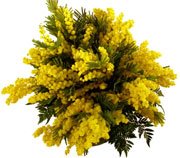
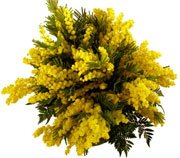
 March has always been my favourite month: March is impregnated of fresh scents like the first crocuses and violets blooming through the last poodles of snow; March has a sparkling sweet wind blowing all along, preluding the arrival of spring; and March celebrates the International Women's Day! In Italy and several other countries it is tradition to offer a branch of mimosas to women: for a day schools, homes, shops, offices are brightened by these happy yellow dots!
Did you know that "the first IWD was held on 19 March 1911 in Germany, Austria, Denmark and further European countries; German women selected this date because in 1848 the Prussian king had promised the vote for women"?
I didn't, until I bumped into the IWD home site. Today is not just an excuse to get flowers and gifts; today is a day we should take the time to ponder how far women have made it thanks to the determination and the will of some great women in the past, and how much there is still to be done to reach a true equality in society.
So this post is dedicated to all the phenomenal women I know and have crossed my life, those who have inspired me in history, and those who I have been fortunate to meet through this blog!
To Ajenji, Agnes, Alessandra, Alice, Amy, Ana, Andrea, Anna, Anna Marie, Corey, Biba, Dalian, Deirdre, Ellen, Francesca, Giulia, Grandma, Hanne, Janet, Jenny, Laura, Lilian, Lisa, Luisella, Mai, Marianne, Maurizia, Monica, Mum, Nancy, Petra, Pat, Piera, Ruth, Sandrine, Saskia, Sebla, Sevgi, Silvia, Susanne, Tamou, Tori, Virna.


Thursday, March 02, 2006
Choosing a last name for your French baby!
In most countries a legitimate child still takes the father's last name . France took a huge leap forward on January 1, 2005 (joining the already progressive Germany and Denmark) by passing a law which allows parents to choose for their children among the father's and the mother’s last name, or even to give both of them, in whichever order they prefer!
This beats the already forward Spanish system, where everyone carries both last names, but it is the father’s last name that’s transmitted to the descendants.
Only in case of disagreement between the parents, the father’s name will prevail. And, whatever has been chosen for the first child, will apply to all the other siblings.
As a mum, I find this change very gratifying. As an Italian mum, I find it even more democratic and equalizing (in my home country the patriarchal leverage still reigns). So it is not just up to my brother to ensure that the family name will continue existing, I can have that perpetrating role too, for at least the space of one generation. It’s amazing how strongly we are conditioned otherwise, in this sense: I was explaining this to my mum and was telling her that I was considering adding my last name to my son. And I said “It makes even more sense, since I’ll have two boys!” And suddenly realized that it would have made exactly the same sense if I had girls! Shame on me…
This new exciting measure comes with a quite whimsical aftermath, check this out:
When choosing the double names option, the last names will be separated by a double dash (--), to avoid confusion with double last names pre-existing the law (which are still quite frequent in France).
So, in concrete terms, for the first generation there are 4 simple options:
Mr. Martin and Madame Dupont have a child, Pascal. They have the four following options:
This beats the already forward Spanish system, where everyone carries both last names, but it is the father’s last name that’s transmitted to the descendants.
Only in case of disagreement between the parents, the father’s name will prevail. And, whatever has been chosen for the first child, will apply to all the other siblings.
As a mum, I find this change very gratifying. As an Italian mum, I find it even more democratic and equalizing (in my home country the patriarchal leverage still reigns). So it is not just up to my brother to ensure that the family name will continue existing, I can have that perpetrating role too, for at least the space of one generation. It’s amazing how strongly we are conditioned otherwise, in this sense: I was explaining this to my mum and was telling her that I was considering adding my last name to my son. And I said “It makes even more sense, since I’ll have two boys!” And suddenly realized that it would have made exactly the same sense if I had girls! Shame on me…
This new exciting measure comes with a quite whimsical aftermath, check this out:
When choosing the double names option, the last names will be separated by a double dash (--), to avoid confusion with double last names pre-existing the law (which are still quite frequent in France).
So, in concrete terms, for the first generation there are 4 simple options:
Mr. Martin and Madame Dupont have a child, Pascal. They have the four following options:
- Pascal Martin
- Pascal Dupont
- Pascal Martin -- Dupont
- Pascal Dupont -- Martin
But what will happen when the second generation will procreate?
If Pascal Dupont--Martin meets Mademoiselle Sylvie DUCHAMPS -- DUBOIS de LACIME, their child will have no less than 14 probabilities:
- DUPONT
- DUCHAMPS
- MARTIN
- DUBOIS DE LACIME
- DUPONT -- MARTIN
- DUCHAMPS -- DUBOIS DE LACIME
- DUPONT -- DUBOIS DE LACIME
- DUBOIS DE LACIME -- DUPONT
- MARTIN -- DUBOIS DE LACIME
- DUBOIS DE LACIME -- MARTIN
- DUPONT -- DUCHAMPS
- DUCHAMPS -- DUPONT
- MARTIN -- DUCHAMPS
- DUCHAMPS --MARTIN
Certainly, carrying out genealogic researches in a few centuries will be no fun, however by then mega databases will be available and search engines as we know them will be a vague souvenir.
This feels like real progress to me! For once, let me proclaim "Vive la France!"
Multilingual Olympic Medal

The Olympic flame estinguished on Sunday night after two exctiting weeks, but the competitive spirit remains alive! In all honesty, we did not achieve ALL the goals we had set for ourselves, but the most important thing is that Milo's lingusitic development has literally exploded, and he has learnt an impressive amount of vocabulary in the past two weeks!
New words in Italian: libro (book), cucchiaio (spoon), pepipio (for pper favore, please), cacincia (for calzina, little sock), pacincia (for patatina, chip), blu, osso (for rosso, red) giao (for giallo, yellow), tappo (hood), amone (for amore, love), attento (be careful), letto (bed), iso (for riso, rice), etc.
Dutch: dicht (closed) , tekenen (to draw), ja (yes), ne (no), cadeautje (little present), etc.
French: bateaux (boat), train, pompier (fire man), parti (gone), pantalon (trousers), poussette (stroller), main (hand), pied (foot), tete (head) and more.
This morning while we were all getting ready he uttered his first mixed phrase , in Italian and Dutch: "Acqua piú...deur dicht!" (=no more water..the door is closed).
This medal is for you, Milo!
Tuesday, February 28, 2006
IT'S A(nother) BOY!
The sonogram this morning gave us a 95% of probability: Milo is getting a little brother! Lots of intense emotions stirred in my soul during this priviledged encounter: the profile of the little one appeared neatly on the monitor, we saw him sucking his thumb while the doctor measured his cranium and legs and abdomen etc. Then he seemed to be scratching his nose, playing with his tiny and already wonderfully designed hands...a boy...an encounter with our destiny: one path we will not walk on, another path opens wide ahead of us! Life with two boys! Cars, airplanes, wrestling, footballs, robots, computers, blues and greens, action, sports...I'm sinking gently in the feeling, starting to feel like a Queen Bee! It was so precious meeting you , little boy, now we are gonna find you a lovely name!
Wednesday, February 22, 2006
Multi Tongue Kids joins 'The Expat Blog'
Happy to announce we just got listed in the France section of Expat Blog, a great site collecting blogs from expats worldwide, but not only: very useful resources and forums where all sorts of information is available to those who are about to expatriate, or simply want to dream about life on the other side of the planet!
Tuesday, February 21, 2006
Multicultural Patriotism : is there such a thing ?
I have been following closely the Torino Winter Olympics, for various reasons: I’m an ex professional athlete and always admired the Olympians; I’m originally from the Piedmont region and am proud of the great job it is doing hosting such an exciting and world-class event; the company I work for is a sponsor and I have enjoyed discovering this aspect of Olympic support as well as the realms of sports marketing. But, above all, these winter Olympics are making me ponder about patriotism.
Milo’s dad and I had this discussion the other night: I was explaining him how Italians feel particularly patriotic during major international sport events, how I never really learnt the Italian national anthem until a few years ago, however if a Soccer World Cup or an Olympic game was up, I have always warm-heartedly cheered for my country (like every night in the last ten days).
Milo’s dad said he never really felt particularly patriotic (although he’s nicknamed ‘The Ambassador (of Belgium),’ since he’s one of the proudest Belgians I have ever met!). Belgium being a country dealing with an uneasy tension between the Walloon and the Flemish communities, and also having a tri-parliamentary structure (a significant Germano-phone community is represented as well), clearly has little room for patriotism. He also explained how showing off Flemish pride, by waving flags and shouting hymns, has been considered a behavior typical of the (extreme) right wing. So, no flag, no hymn for him growing up.
I remember starting wondering about patriotism when I first landed the US at age 19: I was amazed at the omnipresence of the American flag in front of public buildings (such as the post office, the mall, etc.). The national anthem would be played before every game at intercollegiate sports. My volleyball team was not exempt, and I always felt a little awkward about it. I was the only one in the roster without her hand on her heart. It’s easy to understand that North America has played well the patriotism factor to provide a common denominator to all the diverse cultures present on its sole. And still, there is something nice about the anthem and about feeling very much part of one nation.
I attended Seton Hall University, in NJ and was on the volleyball team. At the time, another fellow Italian, Marco Lokar, was on the (more media visible) basketball team. Something occurred to him in those years which took my definition of patriotism to another level. When the first war in Iraq broke, you might remember, Americans massively supported operation Desert Storm by displaying and wearing a yellow ribbon. Within the sports arena, athletes at all levels begun wearing an American flag stitched to their uniform. Marco refused to, on the ground that he was a pacifist, that he was not supporting the war and was not supporting just the American troops but his heart was behind all soldiers involved in the conflict, on both sides. On February 2, 1991, Seton Hall played St John’s University at Madison Square Garden in NY City and the public and the media picked on his “lack of solidarity”. This caused a nation wide debate and created a huge upheaval, which resulted with him leaving the country a few weeks later, after having received several threatening phone calls and serious menaces (see this article on Sports Illustrated for the full story and a very moving profile of Marco Lokar, who happens to be also a true multicultural man with Slovenian and Italian roots).
Shortly after this incident all the sports teams were summoned by the athletic department director who wished no more negative media attention stirring (there were quite some foreign athletes, in my team I was along with an Argentinian and a Puerto Rican). He asked us to think it over and to decide as a team whether we would want to wear the flag or not. I was less idealistic than Marco, although I knew him and respected him. We have had several conversations on the topic. Italy was also engaged with troops in the Gulf. The volleyball team played the following games displaying the American flag on the uniform. This episode has more to do with moral values than with patriotism, however it was the first time I clearly felt “I am not from here” and realized the power of such notions even in a country like the United States, where individual freedoms (such as free thinking!) are at the base of its democracy.
But besides identifying with a flag and a song, what does it mean to feel patriotic today and is patriotism a value that will make sense for our multicultural children? Wikipedia says: “The word patriotism is used to describe emotions and attitudes, political views, symbolism, and specific acts, with respect to a political community - its territory, history, culture, values, and symbol.”
Milo’s dad asked me if I really felt Italian and why. I did not think much about it and words poured out of my mouth. I do feel Italian, even though at this point I lived half of my life abroad and have embraced many American values, like working ethics and style, or a certain positive openness. But I feel very much attached to the cultural heritage of my country. When I’m at the opera and I listen to a performance in Italian, it’s sheer pleasure; something tickles in my genes. The same for certain literature pieces, or for aesthetics, design, for certain foods, certain landscapes. It’s what I hope to convey to Milo from my side: a precise sense of belonging, a certain sensitivity, which extends to nurturing friendship and relationship with others; the importance of the family nucleus, of celebrations; the sacred sense of hospitality. Perhaps I am mixing too many things at once. I don’t know if that means being patriotic.
Would I die for my country? I honestly think that today nobody should die, for any country. And I have not been a good citizen, as I have barely voted ever since I have been of age. Does that make me less patriotic? Does it make my pride for the Italian men’s Cross-Country Skiing gold medal and my sadness for the ice dancing Italian couple placed 6th less valuable? Am I less patriotic because, finally, I decide to pursue a career abroad, and don’t plan on living in Italy any longer? Or because I am not a soccer fan and never spent a Sunday of my life glued to the TV screen following the ligue games?
I can’t help wondering what Milo’s feelings will be. If we end up settling in France, will he inevitably feel French, even if he will be regularly staying in Italy and Belgium and other places? If he will have any sport ambition, will it matter to him which national team he will integrate? Will he feel a chill when he will listen to Charles Aznavour the way I sigh when I listen to Eugenio Finardi or Lucio Battisti? Where will he feel comfortable, where will he belong? I have already explored the theme of Third Culture Kids in another post, which relates to these issues as well. I struggle trying to imagine his feelings, how his identity will be permeated by the exposure to three cultures. There is something reassuring in knowing you come from one place, with deep and specific roots. He will be certainly enriched by the fact that his roots are spread around, but will this mean that patriotism will mean next to nothing to him?
Will there ever be a strong feeling of European-wide patriotism? At present times, it seems, Euro skepticism is more voiced. I felt “European” for the first time in graduate school, in California. The university had a high incidence of foreign students, equally spread among Europeans and Asians. Although I remember it as the most fulfilling and enriching multicultural experience in my life, I also remember very strongly that the Europeans immediately clung together and so did the Asians. We recognized in each other a certain common sensitivity for things, we had the same reactions. My friend Holger from those years recently emailed me his dismay for the current world events, and mentioned nostalgically how back then “people from all over would get along so well with each other.” (I also think it had to do with socio-economics, we were all coming from similar middle class miens and this made it certainly easy to interact. I don’t mean to make a classist remark here, but it is a considerable fact).
In conclusion, this will be one fascinating learning experience in watching Milo grow into an independent man. I cannot but wish that patriotism for him will have only positive connotations of olympic breath.
Milo’s dad and I had this discussion the other night: I was explaining him how Italians feel particularly patriotic during major international sport events, how I never really learnt the Italian national anthem until a few years ago, however if a Soccer World Cup or an Olympic game was up, I have always warm-heartedly cheered for my country (like every night in the last ten days).
Milo’s dad said he never really felt particularly patriotic (although he’s nicknamed ‘The Ambassador (of Belgium),’ since he’s one of the proudest Belgians I have ever met!). Belgium being a country dealing with an uneasy tension between the Walloon and the Flemish communities, and also having a tri-parliamentary structure (a significant Germano-phone community is represented as well), clearly has little room for patriotism. He also explained how showing off Flemish pride, by waving flags and shouting hymns, has been considered a behavior typical of the (extreme) right wing. So, no flag, no hymn for him growing up.
I remember starting wondering about patriotism when I first landed the US at age 19: I was amazed at the omnipresence of the American flag in front of public buildings (such as the post office, the mall, etc.). The national anthem would be played before every game at intercollegiate sports. My volleyball team was not exempt, and I always felt a little awkward about it. I was the only one in the roster without her hand on her heart. It’s easy to understand that North America has played well the patriotism factor to provide a common denominator to all the diverse cultures present on its sole. And still, there is something nice about the anthem and about feeling very much part of one nation.
I attended Seton Hall University, in NJ and was on the volleyball team. At the time, another fellow Italian, Marco Lokar, was on the (more media visible) basketball team. Something occurred to him in those years which took my definition of patriotism to another level. When the first war in Iraq broke, you might remember, Americans massively supported operation Desert Storm by displaying and wearing a yellow ribbon. Within the sports arena, athletes at all levels begun wearing an American flag stitched to their uniform. Marco refused to, on the ground that he was a pacifist, that he was not supporting the war and was not supporting just the American troops but his heart was behind all soldiers involved in the conflict, on both sides. On February 2, 1991, Seton Hall played St John’s University at Madison Square Garden in NY City and the public and the media picked on his “lack of solidarity”. This caused a nation wide debate and created a huge upheaval, which resulted with him leaving the country a few weeks later, after having received several threatening phone calls and serious menaces (see this article on Sports Illustrated for the full story and a very moving profile of Marco Lokar, who happens to be also a true multicultural man with Slovenian and Italian roots).
Shortly after this incident all the sports teams were summoned by the athletic department director who wished no more negative media attention stirring (there were quite some foreign athletes, in my team I was along with an Argentinian and a Puerto Rican). He asked us to think it over and to decide as a team whether we would want to wear the flag or not. I was less idealistic than Marco, although I knew him and respected him. We have had several conversations on the topic. Italy was also engaged with troops in the Gulf. The volleyball team played the following games displaying the American flag on the uniform. This episode has more to do with moral values than with patriotism, however it was the first time I clearly felt “I am not from here” and realized the power of such notions even in a country like the United States, where individual freedoms (such as free thinking!) are at the base of its democracy.
But besides identifying with a flag and a song, what does it mean to feel patriotic today and is patriotism a value that will make sense for our multicultural children? Wikipedia says: “The word patriotism is used to describe emotions and attitudes, political views, symbolism, and specific acts, with respect to a political community - its territory, history, culture, values, and symbol.”
Milo’s dad asked me if I really felt Italian and why. I did not think much about it and words poured out of my mouth. I do feel Italian, even though at this point I lived half of my life abroad and have embraced many American values, like working ethics and style, or a certain positive openness. But I feel very much attached to the cultural heritage of my country. When I’m at the opera and I listen to a performance in Italian, it’s sheer pleasure; something tickles in my genes. The same for certain literature pieces, or for aesthetics, design, for certain foods, certain landscapes. It’s what I hope to convey to Milo from my side: a precise sense of belonging, a certain sensitivity, which extends to nurturing friendship and relationship with others; the importance of the family nucleus, of celebrations; the sacred sense of hospitality. Perhaps I am mixing too many things at once. I don’t know if that means being patriotic.
Would I die for my country? I honestly think that today nobody should die, for any country. And I have not been a good citizen, as I have barely voted ever since I have been of age. Does that make me less patriotic? Does it make my pride for the Italian men’s Cross-Country Skiing gold medal and my sadness for the ice dancing Italian couple placed 6th less valuable? Am I less patriotic because, finally, I decide to pursue a career abroad, and don’t plan on living in Italy any longer? Or because I am not a soccer fan and never spent a Sunday of my life glued to the TV screen following the ligue games?
I can’t help wondering what Milo’s feelings will be. If we end up settling in France, will he inevitably feel French, even if he will be regularly staying in Italy and Belgium and other places? If he will have any sport ambition, will it matter to him which national team he will integrate? Will he feel a chill when he will listen to Charles Aznavour the way I sigh when I listen to Eugenio Finardi or Lucio Battisti? Where will he feel comfortable, where will he belong? I have already explored the theme of Third Culture Kids in another post, which relates to these issues as well. I struggle trying to imagine his feelings, how his identity will be permeated by the exposure to three cultures. There is something reassuring in knowing you come from one place, with deep and specific roots. He will be certainly enriched by the fact that his roots are spread around, but will this mean that patriotism will mean next to nothing to him?
Will there ever be a strong feeling of European-wide patriotism? At present times, it seems, Euro skepticism is more voiced. I felt “European” for the first time in graduate school, in California. The university had a high incidence of foreign students, equally spread among Europeans and Asians. Although I remember it as the most fulfilling and enriching multicultural experience in my life, I also remember very strongly that the Europeans immediately clung together and so did the Asians. We recognized in each other a certain common sensitivity for things, we had the same reactions. My friend Holger from those years recently emailed me his dismay for the current world events, and mentioned nostalgically how back then “people from all over would get along so well with each other.” (I also think it had to do with socio-economics, we were all coming from similar middle class miens and this made it certainly easy to interact. I don’t mean to make a classist remark here, but it is a considerable fact).
In conclusion, this will be one fascinating learning experience in watching Milo grow into an independent man. I cannot but wish that patriotism for him will have only positive connotations of olympic breath.
Wednesday, February 15, 2006
Olympic performance update
The Winter Olympics are passionately ongoing, and so are our Multilingual Olympics, trying very much to stay in schedule and perform at our best!
- Among new words learn from Milo there are snow, please, friend, all with its Italian, French and Dutch counterpart. He’s actually sponging up vocabulary every day, he tunes in at whatever is being said and repeats virtually everything, which I believe it’s quite normal at 21 months. He does not repeat much of the English conversation he catches between myself and Milo’s dad, however his pronounciation in Italian is starting to have a distinct Anglophone accent.
He has a harder time repeating certain sounds, so he make s up his own interpretation. A few example:
-His name, Milo: he has been calling himself ‘Memo’, and lately that has shifted to ‘Mímio’ (we found it adorable and already elected it as his nickname, being Milo already so short!).
-Amico (friend): he gets the meaning of the word, but says ‘pepípio’. He gets the right number of sillables and the musicality of the word, but he substitutes certain sounds with labial sounds.
-Biro (pen) and other words with the “r”: he can’t roll the r, so he stretches the preceding vowel (biiiio)
-Luce (light) is uu-chi - On a good note, he’s more and more aware of the different identities that the same object has in our household. He proudly recites main, manina and handje (hand respectively FR, IT and D), or avion, aereo, vliegtuig (airplane).
- My Dutch efforts have stalled a little and I need to brush up; here are my next phrases for the week:
Heel leuk u te ontmoeten (I'm very glad to meet you)
Ik versta het niet (I don't understand)
Ik begrijp het heel goed (I understand perfectly) - The Italian conversations are also slagging behind, somehow it does not come natural. I guess we just have to go to Italy more often, then!
While we were watching the opening ceremony held in Torino on Friday, as the athletes were parading we cheered enthusiastically for all of them (I always get tear-eyed on these occasions!); however, when Italy paraded at last, I could not resist a spur of nationalistic pride and I involved Milo in a typical supporting cheer:
"I-TA-LIA! I-TA-LIA!" we screamed rhythmically, clapping our hands and stumping our feet.
Apparently, he enjoyed it: ever since, from time to time he shouts out “I-TA-LIA”! He even taught it to Antoine this morning (I hope his parents won’t think we’re brain washing their kid!).
The Belgian delegation paraded with a mere 8 athletes; if Milo will be any good in sports, then perhaps we will see him competing with the Belgian flag in 2022?!
Tuesday, February 14, 2006
La betise, or the art of making mistakes
The word of the week for Milo is betise, which French parents use to indicate something a kid does that he should have not done, like breaking an object, touching something forbidden etc.
He must have had his share with the nanny this week, because as soon as he does one, he labels it himself immediately: “Betich!” he says seriously, as he’s throwing his apple on the floor during lunch.
“Betich!” he declares while he spills his water on the sofa.
“Betiiiiich” he stresses while he takes is crayon and attempts decorating the white walls, after I told him not to for the 100th time.
The translation in English would be ‘silly thing.’ In Italian we don’t have a specific word, we’d say ‘stupidaggine’ (silly thing) or ‘marachella’ (naughtly thing).
I asked Milo’s dad how would he say that in Dutch. He claims they don’t have that particular word because Flemish kids simply don’t do betise!
He must have had his share with the nanny this week, because as soon as he does one, he labels it himself immediately: “Betich!” he says seriously, as he’s throwing his apple on the floor during lunch.
“Betich!” he declares while he spills his water on the sofa.
“Betiiiiich” he stresses while he takes is crayon and attempts decorating the white walls, after I told him not to for the 100th time.
The translation in English would be ‘silly thing.’ In Italian we don’t have a specific word, we’d say ‘stupidaggine’ (silly thing) or ‘marachella’ (naughtly thing).
I asked Milo’s dad how would he say that in Dutch. He claims they don’t have that particular word because Flemish kids simply don’t do betise!
Monday, February 13, 2006
Multi Tongue Kids joins 'The Paris Blog' !
If you want to have an off-beat peek at the scene in Paris these days, check out The Paris Blog (formerly In Paris Now), a group blog in English about life in Paris, edited by Laurie. The variety of topics covered is such that the entertainment value is guaranteed!
Excerpts from MULTI TONGUE KIDS' entries will be shared regularly, linking back to the home site ('The Garde Partagée' entry has already been posted on Feb. 10, re-titled Two-Timing Nanny, complete with a lovely picture!).
Excerpts from MULTI TONGUE KIDS' entries will be shared regularly, linking back to the home site ('The Garde Partagée' entry has already been posted on Feb. 10, re-titled Two-Timing Nanny, complete with a lovely picture!).
Friday, February 10, 2006
Olympic Day 1
The Opening Ceremony will be held tonight at the dinner table!
Some crepes flambées au Grand Marnier will symbolize the arrival of the Olympic Torch!
Napkins displaying the flags of our countries (Italy, Belgium, France and an honorary USA one as well) will remind us of our multicultural richness!
We will all swear to competing honestly and at the best of our possibilities, on De Cubertain’s credo that the important is to participate!
We’ll parade in the living room with our flags!
We’ll greet the imaginary spectators and feel moved to be there!
As for the challenges:
-My Dutch greeting of the day is: Ik spreek maar een klein beetje Nederlands (I only speak a little Dutch).
-Milo’s word will be: snow (neve (IT), nege (FR) and I have to check in Dutch)
-As far as the conversation in Italian, I hope to have something fun to report on next week!
Altius, Citius, Fortius!
Tuesday, February 07, 2006
Olympic challenge : 2006 Multilingual Children’s Olympics
The Turin Winter Olympics will start in 3 days (on February 10) and will last for 2 weeks. I salute the Olympic spirit and embrace the Olympic Challenge proposed by the Multilingual Children Association, to engage in a two weeks of MULTILINGUAL CHILDREN OLYMPICS!
Our goals:
- We will teach Milo 1 new word a day in Dutch, Italian and French.
- I will learn basic Dutch greetings and small talks phrases.
- Milo’s Dad will carry one conversation a day in Italian with me.
Stay tuned for a gold medal performance!
Feel free to sign up for the challenge by visiting the Multilingual Children’s Association website. (Hosted in California, it has been founded by a Swedish woman who’s raising her daughters bilingual. This site fills a great gap in terms of information, resources and centralized forums among multilingual parents).
Our goals:
- We will teach Milo 1 new word a day in Dutch, Italian and French.
- I will learn basic Dutch greetings and small talks phrases.
- Milo’s Dad will carry one conversation a day in Italian with me.
Stay tuned for a gold medal performance!
Feel free to sign up for the challenge by visiting the Multilingual Children’s Association website. (Hosted in California, it has been founded by a Swedish woman who’s raising her daughters bilingual. This site fills a great gap in terms of information, resources and centralized forums among multilingual parents).
Multilingualism, way to go!
Check out this article form the CBS News site citing the opinion of British Language Analyst David Graddol, who says multilingualism is the way of the future; while English has played the role of the great common denominator, less and less people worldwide will be English native speakers by 2050 and new generations of bilingual and multilingual speakers will gradually take over the linguistic map. Sounds good, doesn't it?
Friday, February 03, 2006
The advantages of the Garde Partagée - Part II
In our particular case, what this arrangement has provided is a fully French environment and person of reference for Milo, in order to apply correctly the OPOL method.
In fact, our nanny is originally from Morocco, and if we didn’t already have all these languages to deal with, I would have been keen on her speaking Arabic to Milo. But we commonly decided that she sticks to French, so during the day Milo is in a 100% francophone environment.
This has been proving very fruitful: this week Milo pronounced his first full sentence in French:
“Elle est partie ma maman ?" (Has my mum left?)
It was originally “Elle est partie ta maman” (Has YOUR mum left), since it was Antoine who posed the question and Milo kept on repeating it. The nanny eventually corrected him and personalized it!
At night the nanny keeps me up to date on new words learnt and topic addressed, so that we can provide the Italian and Dutch counterpart, and viceversa on Monday mornings. So far we feel he has progressed rather homogeneously in all three languages.
Sometimes I wonder, had I been a stay at home mummy, the advantages would have been others, of course, but how would we have handled the French language acquisition?
This is the issue that a couple of friends are currently facing, and they decided to sacrifice their own languages, unfortunately. Here’s the case study:
The Mum is Egyptian and speaks Arabic, Italian and French fluently. The father is Anglo-Italian and has been raised in both English and Italian. Their 20 month old Gabriel is looked after at home by his mum (together with his 3 months old sister) and is being raised in French primarily. The parents switch easily between Italian and French among one another. They fear that if he does not hear French enough he’ll have a hard time once he’ll enter school. Hopefully he’ll pick up all of the other languages later on.
In fact, our nanny is originally from Morocco, and if we didn’t already have all these languages to deal with, I would have been keen on her speaking Arabic to Milo. But we commonly decided that she sticks to French, so during the day Milo is in a 100% francophone environment.
This has been proving very fruitful: this week Milo pronounced his first full sentence in French:
“Elle est partie ma maman ?" (Has my mum left?)
It was originally “Elle est partie ta maman” (Has YOUR mum left), since it was Antoine who posed the question and Milo kept on repeating it. The nanny eventually corrected him and personalized it!
At night the nanny keeps me up to date on new words learnt and topic addressed, so that we can provide the Italian and Dutch counterpart, and viceversa on Monday mornings. So far we feel he has progressed rather homogeneously in all three languages.
Sometimes I wonder, had I been a stay at home mummy, the advantages would have been others, of course, but how would we have handled the French language acquisition?
This is the issue that a couple of friends are currently facing, and they decided to sacrifice their own languages, unfortunately. Here’s the case study:
The Mum is Egyptian and speaks Arabic, Italian and French fluently. The father is Anglo-Italian and has been raised in both English and Italian. Their 20 month old Gabriel is looked after at home by his mum (together with his 3 months old sister) and is being raised in French primarily. The parents switch easily between Italian and French among one another. They fear that if he does not hear French enough he’ll have a hard time once he’ll enter school. Hopefully he’ll pick up all of the other languages later on.
Milo and Antoine: an adventure called 'garde partagée' (part I of II)
When I was six month pregnant, I had to go to the city hall and sign up for a daycare waiting list for Milo. It was a very weird sensation: the baby was not even born yet, and there I was, crossing my fingers and begging an inflexible adjoint maire for a place in one of the half a dozen daycares available in our neighborhood. The demand being immense, we did not get a spot. So, like many other Parisians who do not wish to interrupt one of the parent’s career, we opted for another home made solution: la garde partagée (literally ‘split guard’). The concept is easy: two families share a nanny, who looks after two babies, taking turns: one week at each baby's house. The only requirement is for the families to live very close by, in order to save on transfer time in the mornings and evenings, and to agree on most financial, logistical, nutritional or educational issues that such a venture might arise.
We started when Milo was 8 months, and we found rather easily a family already equipped with a super nanny (there’s an abundant numbers of websites where parents can investigate the issue and touch base with other parents).
It has been exactly one year now, and we are totally satisfied about this experience, especially because we have been lucky to find a star of a nanny. Milo has been looked after together with Antoine, a French boy six months his senior.
Milo and Antoine have become like little brothers, they share their days, toys and escapades to the park, socializing among one another.The financial weight is important, although the French government allows for a substantial tax write off for hiring home personnel. The advantages are numerous: Milo did not have to adapt to a totally new environment (in our case the arrangement is that the kids are always at out place), they get individualized care and attention, they are not constantly exposed to the millions of bacteria and microbes that circulate in daycare, if they fall sick the nanny comes anyway and I am not obliged to stay at home, etc.
Antoine’s 6 months leverage has been an accelerating factor in Milo’s physical development, while now it's a great one for his verbal development in French. It's fun to hear the two exchanging full sentences, often about nonsense...They look after each other, they learn how to share and to do things together, they fight, they cuddle, just like two siblings!
When I come home at night, competition peaks for attention! Antoine has become part of the family and I naturally greet him as such, but Milo is VERY possessive of his mummy, and has made clear numerous times that he has got attention priority!
The cultural exchange is even: I have been singing to them little Italian rhyming songs, and Antoine is also now capable of singing them in flawless Italian!
The harmony between the two is guaranteed by the nanny, who happens to have a very charming and solar personality, and from day one has interacted with them a lot, playing and truly teaching them not only words and games, but also manners.During the weekend we are always impressed to see how Milo asks about his little friend and the vice-Mum, they have become very much part of his life, and when we go on trips, finding them back is a source of joy for him! This arrangement has made my going back to work much easier, although the first months I was naturally very apprehensive. It is a great human experience.
Next September Antoine will start kindergaden but only in the mornings (and on Wednesdays schools are shut in France!), so we will continue the adventure until at least December. After that I hope some school will accept Milo, even if he will not be three yet; I am already investigating the matte, a year in advance: life in a metropolis gives the expression “planning ahead” another meaning!
We started when Milo was 8 months, and we found rather easily a family already equipped with a super nanny (there’s an abundant numbers of websites where parents can investigate the issue and touch base with other parents).
It has been exactly one year now, and we are totally satisfied about this experience, especially because we have been lucky to find a star of a nanny. Milo has been looked after together with Antoine, a French boy six months his senior.
Milo and Antoine have become like little brothers, they share their days, toys and escapades to the park, socializing among one another.The financial weight is important, although the French government allows for a substantial tax write off for hiring home personnel. The advantages are numerous: Milo did not have to adapt to a totally new environment (in our case the arrangement is that the kids are always at out place), they get individualized care and attention, they are not constantly exposed to the millions of bacteria and microbes that circulate in daycare, if they fall sick the nanny comes anyway and I am not obliged to stay at home, etc.
Antoine’s 6 months leverage has been an accelerating factor in Milo’s physical development, while now it's a great one for his verbal development in French. It's fun to hear the two exchanging full sentences, often about nonsense...They look after each other, they learn how to share and to do things together, they fight, they cuddle, just like two siblings!
When I come home at night, competition peaks for attention! Antoine has become part of the family and I naturally greet him as such, but Milo is VERY possessive of his mummy, and has made clear numerous times that he has got attention priority!
The cultural exchange is even: I have been singing to them little Italian rhyming songs, and Antoine is also now capable of singing them in flawless Italian!
The harmony between the two is guaranteed by the nanny, who happens to have a very charming and solar personality, and from day one has interacted with them a lot, playing and truly teaching them not only words and games, but also manners.During the weekend we are always impressed to see how Milo asks about his little friend and the vice-Mum, they have become very much part of his life, and when we go on trips, finding them back is a source of joy for him! This arrangement has made my going back to work much easier, although the first months I was naturally very apprehensive. It is a great human experience.
Next September Antoine will start kindergaden but only in the mornings (and on Wednesdays schools are shut in France!), so we will continue the adventure until at least December. After that I hope some school will accept Milo, even if he will not be three yet; I am already investigating the matte, a year in advance: life in a metropolis gives the expression “planning ahead” another meaning!
Wednesday, February 01, 2006
Signaling pain
A vicious gastrointeritis virus is taking Paris by the storm these days, and Milo caught it. He was suspiciously quiet all day yesterday and as soon as I got home and the nanny left, he suddenly begun throwing up on himself. It was the first time this happened to him and I could sense his preoccupation in trying to understand what was it all about. But the main evolution lays in the fact that, for the first time, he signaled his pain and where he felt it.
“Mamma…bibi, bibi...” he moaned several times, while rubbing his belly.
Another step forward toward efficient communication!
“Mamma…bibi, bibi...” he moaned several times, while rubbing his belly.
Another step forward toward efficient communication!
Tuesday, January 24, 2006
Milo, the powerful switch finder!
SCENE I
Paris, Orly Airport: on a cold January morning, we de-boarded the flight from Turin and we proceed to the baggage claim via an endless daedalus of corridors and moving walkways. I usually travel without the stroller, and carry my 15 kilos bundle of joy all the way until I can find a cart on which to seat him. This time, I enjoyed his independence spur and let him trot alongside me with pleasure. Upon approaching the first walkway, his eyes widened with interest and curiosity. Once boarded, he kept looking back and forth, as if he was trying to gauge the speed of travel! Descending went flawlessly, I was starting to think: "This is almost fun..," when I see Milo sprinting to the next walkway, dashing to the floor to press, under the rubber hand rail, a seemingly harmless red little button: it immediately stopped the moving walkway ahead of us, a 200 mt. stretch filled with passengers, who, tilted forward by inertia, cursed each in its own language and wondered what the heck was wrong with these Parisian airports! I threw my bag, ran to the button and pushed it feverishly several times hoping to reactivate the walkway, but of course this was only the stopping button! No airport security or officials were on sight: I grabbed my son, who looked very impressed and proud, and kept walking really fast to the baggage claim…
SCENE II
Two days later, on a still icy cold Sunday morning, Milo and I met two mums-girlfriends at a non-disclosed Parisian museum, for what was supposed to be a morning of culture and entertainment. They also brought along their 9 months and 4 months babies, so we are all equipped with bulgy strollers and the typical paraphernalia that mums travel with these days, not to mention coats, scarves and the whole fit. The museum in question is a small little renaissance jewel, and despite their lack of equipment to welcome handicapped visitors or mums with strollers, the staff was very keen on helping us enter the premises and overcome a series of staircases and passages. Milo was particularly excited by the venue and the presence of the two babies, and was giving the best of himself: he sang, he run around exploring every little alley or secret door, he wanted to climb every staircase in sight, he kept me busy the whole time; the other mums were also taking turns with breastfeeding stops, diaper changing sessions, stroller parking or rescuing, etc. It was everything but a relaxing visit and we hardly managed to pay attention to the paintings of the neo realist we had mainly gone there for…at one point we found a quiet room where there was only a large ancient tapestry hanging on one wall and a padded bench in the middle of the room. We gained the bench to rest a little and we could hardly start the conversation again, when we suddenly heard a mechanical noise and we noticed that the museum curtains were all suddenly lifting: the two guards of the room exchanged a slightly interrogative look and then turned toward a corner of the room, where, sure enough, little Milo had found the switch (behind a table and the above mentioned curtain) which controlled the curtains of the entire floor! Luckily the guards were more amused than bothered by Milo’s bravado, and we left soon after for a danger-free walk in the nearby park!
Paris, Orly Airport: on a cold January morning, we de-boarded the flight from Turin and we proceed to the baggage claim via an endless daedalus of corridors and moving walkways. I usually travel without the stroller, and carry my 15 kilos bundle of joy all the way until I can find a cart on which to seat him. This time, I enjoyed his independence spur and let him trot alongside me with pleasure. Upon approaching the first walkway, his eyes widened with interest and curiosity. Once boarded, he kept looking back and forth, as if he was trying to gauge the speed of travel! Descending went flawlessly, I was starting to think: "This is almost fun..," when I see Milo sprinting to the next walkway, dashing to the floor to press, under the rubber hand rail, a seemingly harmless red little button: it immediately stopped the moving walkway ahead of us, a 200 mt. stretch filled with passengers, who, tilted forward by inertia, cursed each in its own language and wondered what the heck was wrong with these Parisian airports! I threw my bag, ran to the button and pushed it feverishly several times hoping to reactivate the walkway, but of course this was only the stopping button! No airport security or officials were on sight: I grabbed my son, who looked very impressed and proud, and kept walking really fast to the baggage claim…
SCENE II
Two days later, on a still icy cold Sunday morning, Milo and I met two mums-girlfriends at a non-disclosed Parisian museum, for what was supposed to be a morning of culture and entertainment. They also brought along their 9 months and 4 months babies, so we are all equipped with bulgy strollers and the typical paraphernalia that mums travel with these days, not to mention coats, scarves and the whole fit. The museum in question is a small little renaissance jewel, and despite their lack of equipment to welcome handicapped visitors or mums with strollers, the staff was very keen on helping us enter the premises and overcome a series of staircases and passages. Milo was particularly excited by the venue and the presence of the two babies, and was giving the best of himself: he sang, he run around exploring every little alley or secret door, he wanted to climb every staircase in sight, he kept me busy the whole time; the other mums were also taking turns with breastfeeding stops, diaper changing sessions, stroller parking or rescuing, etc. It was everything but a relaxing visit and we hardly managed to pay attention to the paintings of the neo realist we had mainly gone there for…at one point we found a quiet room where there was only a large ancient tapestry hanging on one wall and a padded bench in the middle of the room. We gained the bench to rest a little and we could hardly start the conversation again, when we suddenly heard a mechanical noise and we noticed that the museum curtains were all suddenly lifting: the two guards of the room exchanged a slightly interrogative look and then turned toward a corner of the room, where, sure enough, little Milo had found the switch (behind a table and the above mentioned curtain) which controlled the curtains of the entire floor! Luckily the guards were more amused than bothered by Milo’s bravado, and we left soon after for a danger-free walk in the nearby park!
Wednesday, January 11, 2006
Expanding the family
On Christmas Eve, we shared the news over the phone with the rest of the family in Italy and Belgium:
"Milo, tell the grandparents what's in here!"I asked, tapping on my belly.
"Bebéeeeeeeee!" screamed enthusiastically our little wonder.
And so the adventure continues: Milo is getting a little sibling this summer! We are again excited and scared, joyful and terrorized , all at once, just like for the first time. Milo has been informed from the very beginning; he knows and understand what a bebé is. He probably does not get the full picture yet, but he has been incredibly attentive and tender, kissing my belly and saying "CIAO, CIAO!" to this bebé!
At the same time, seeing how he can be jealous if I pay attention to his friend Antoine, I am preparing myself for a big jealousy crisis!
In terms of the pregnanacy, so far so good, the first trimester is over, I survived nausea and blues (which I didn't have for Milo) and I feel back in my shoes.
Looking forward to another Multi Tongue Kid!
"Milo, tell the grandparents what's in here!"I asked, tapping on my belly.
"Bebéeeeeeeee!" screamed enthusiastically our little wonder.
And so the adventure continues: Milo is getting a little sibling this summer! We are again excited and scared, joyful and terrorized , all at once, just like for the first time. Milo has been informed from the very beginning; he knows and understand what a bebé is. He probably does not get the full picture yet, but he has been incredibly attentive and tender, kissing my belly and saying "CIAO, CIAO!" to this bebé!
At the same time, seeing how he can be jealous if I pay attention to his friend Antoine, I am preparing myself for a big jealousy crisis!
In terms of the pregnanacy, so far so good, the first trimester is over, I survived nausea and blues (which I didn't have for Milo) and I feel back in my shoes.
Looking forward to another Multi Tongue Kid!
Monday, January 09, 2006
Milo and the doctors
Since Milo's birth we have seen at least 4 or 5 different pediatricians: for some reason we don't seem to find our fit. Lately we have been going to the same doctor, a middle-aged woman whom, I must say, has good no-non sense advises, but happens to have a very callous and austere personality, and has behaved extremely harshly with Milo. I can't say exactly when, he has developed a fear for the stethoscope and, as a consequence, for the lady. Just hearing the word 'doctor' makes him cry. To my astonishment, during our last visit the day he contracted chicken pox, she begun literally shouting at him, intimidating him to stop crying for nothing. Evidently, the lady had missed her Pedagogy 101 courses...
So, needles to say, here I am hunting for the next pediatrician.
I have lived myself with a phobia for everything that concerns the medical world all my life. I could not even have my tension taken without fainting or literally feeling I was going to die. Endless conversations with my parents on the subject never revealed any specific traumatizing episode in my childhood which might have cased this phobia. It's only during the pregnancy that I found the motivation to dig into it and grab the bull by the horn, facing my Achille's heel. A nurse trained in psychology helped me finding not necessarily the causes, but a way to overcome this fear. And ever since Milo's birth, the phobia has dissolved: miracles of motherhood!
Because of this, I have been very attentive to the way Milo lives these experiences, and it really breaks my heart to see him terrorized each time we need to go to the doctor. I have been thinking as a starter to buy a stethoscope and start leaving it around the house, so Milo might familiarize himself with the object, make it eventually a toy. But I also need an understanding counterpart, and I am surprised at how difficult it is to find a pediatrician who's at once gentle and competent.
So, needles to say, here I am hunting for the next pediatrician.
I have lived myself with a phobia for everything that concerns the medical world all my life. I could not even have my tension taken without fainting or literally feeling I was going to die. Endless conversations with my parents on the subject never revealed any specific traumatizing episode in my childhood which might have cased this phobia. It's only during the pregnancy that I found the motivation to dig into it and grab the bull by the horn, facing my Achille's heel. A nurse trained in psychology helped me finding not necessarily the causes, but a way to overcome this fear. And ever since Milo's birth, the phobia has dissolved: miracles of motherhood!
Because of this, I have been very attentive to the way Milo lives these experiences, and it really breaks my heart to see him terrorized each time we need to go to the doctor. I have been thinking as a starter to buy a stethoscope and start leaving it around the house, so Milo might familiarize himself with the object, make it eventually a toy. But I also need an understanding counterpart, and I am surprised at how difficult it is to find a pediatrician who's at once gentle and competent.
Friday, January 06, 2006
La Befana

January 6 in Italy is known as the day of La Befana, an old witch flying on its broom, coming to every house during the night, and leaving a sock full of sweets to the good kids, and a sock full of charcoal for the bad kids. I still remember one year receiving stockings (!) filled with nougat, chocolates and tangerines!
There's also an old ryhme which all Italian kids learn for the occasion:
La Befana vien di notte
con le scarpe tutte rotte!
Viva, viva la Befana
che le feste porta via!
Befana comes at night
with her broken shoes
cheers for the Befana
who sweeps away all the festivities!
HAPPY BEFANA, everyone!
Thursday, January 05, 2006
Counting with Milo
When I was pregnanat, Milo's dad woud periodically count to the belly up to five, in Dutch. It was his way to start communicationg with the baby. He continued doing so once Milo was born, parading him the fingers one by one. Ever since Milo has been talking, he's been waiting anxiously to collect the fruits of his hard work! But for some reason, only number 5 (vijf) seems to have stuck to him. So, no matter how many fingers Daddy shows him, Milo says "vijf!"
I'm less left brain and have not any particularly emphasis on numbers in Italian, but at bath time, I always say: "Uno, due, tre..." and then I lift Milo and put him in the tub. In Italian, it's 2 (due) which stuck to him. So if I show him any finger combination, it's always :"due!"
He's also starting to associate numbers with the written symbols, especially in the morning when he's waiting for his milk bottle to warm up in the microwave and he sees the clock displaying the decreasing seconds: it's either "due, due, due, due due!" or "vijf ,vijf ,vijf!" depending upon who is with him!
...This time the score is: Dutch vs Italian 5-2!
I'm less left brain and have not any particularly emphasis on numbers in Italian, but at bath time, I always say: "Uno, due, tre..." and then I lift Milo and put him in the tub. In Italian, it's 2 (due) which stuck to him. So if I show him any finger combination, it's always :"due!"
He's also starting to associate numbers with the written symbols, especially in the morning when he's waiting for his milk bottle to warm up in the microwave and he sees the clock displaying the decreasing seconds: it's either "due, due, due, due due!" or "vijf ,vijf ,vijf!" depending upon who is with him!
...This time the score is: Dutch vs Italian 5-2!
Wednesday, January 04, 2006
Putting the accent on…accents!
Giovanni’s comment on a previous post got me thinking about accents.
- Why is it that certain accents are pleasant to the ear and others are not?
- Why is it that the French love the British accent (meaning, a British person speaking French with a British accent) while they detest the German one?
- And why is it so ear-acking for the rest of the international community hearing a French speaking English or an American speaking French?
- Why is it considered funny that Japanese can hardly pronounce the “r”?
Certain idiosyncrasis also applies at a more micro level, within languages…
- When I moved to California, after 4 years on the East Coast, I suddenly realized that people back East had an accent (I finally got all those NY “coffee” jockes).
- I have been in France for four years and I am finally recognizing the southern French or the Canadian accent from the Parisian: defintely not the same cup of tea.
Almost every single foreigner I got to meet in my life has told me: “I love the way Italian sound! It’s so musical!” But do they realize that there are dramatically different ways of speaking Italian? Italy is subdivided into 20 regions that little more than 2 centuries ago where single states. Therefore the accents in each reagion are significantly different. It’s really a matter of intonation, you can be saying the same phrase, but singing a completely different song. For political correctness reasons I'll abstain to say which ones I like and which ones I don't, but here are some descriptions:
- I’m from the North West region of Piemonte, and already at the same latitude, the way people from Milano and the Venice region speak catches my ears. We are talking about 2 hours away!
- In Toscana people speak with a distinctive accent, hardly pronoucing their Cs (they aspire them into Hs): Coca Cola in Firenze becomes “hoha hola”!
- The Romans have this curious habit of chopping words and putting the accent on the second to the last vowel. Mangiare becomes 'magná,' dormire becomes 'dormí,' etc. It is very charismatic and it has an intrinsic humorous and contagious value (when you are in Rome after a while you cannot help yourself from doing the same, while the Romans cannot stand a non-Roman talking like them, it really disgusts them!)
- From Rome onwards, the differences are even stronger. It’s not just a matter of accent anymore, often in the southern regions the dialect takes over the Italian language, and these dialects are languages in its own.
My Flemish beau has become astonishling fluent in Italian in the last few years, yet he does not feel like speaking in Italian with me because...he does not recognize me when I speak Italian! It sounds horrible, but I understand him: I am not particularly fond of his Dutch tonalities either! I guess our English softens the respective extreme nuances of our native languages. We spoke English to each other when we met and fell in love, so to hear one another speak another language is like discovering a new person.
Milo is starting to have a somewhat anglophone accent when pronouncing French words with an “r” and some Italian words. A few weeks ago he learnt how to say “mum left” in French (Maman est parti) and he pronounces parti like a British would do! I suspect what I hear as an anglophone accent it's actually the Dutch influence.
Why does this happens and what determines one language vs another to have a stronger influence on a multilingual kid?
The mistery continues…
Monday, January 02, 2006
Milo, the Père Noël and a week long affair with Noddy
The week preceding Christmas I have been sick and felt like I was running around with my head cut off...the excitement that precedes the festivities was mixed with anxiety and fatigue. Everything seemed strange...Milo has been particularly defensive with the occasional Santa Clauses met around town in shops or restaurants: he would look at them suspiciously and refused firmly any contact: "No! No'!"he would shout, looking at them straight in the eyes, as they approached to offer a candy or to shake his little hand. The Père Noël is definitely not this thing!
It has been indeed an unforgettable holiday season: Milo caught chicken pox 2 days before Christmas, his dad and I caught the most vicious flu virus in the whole of France, we had to cancel our trip to Italy and were stranded in deserted and icy cold Paris for the whole week. It was actually a very lovely, intimate Christmas, despite the coughing, the sneezing and poor Milo's red dots all over! We treated ourselves to many healthy naps, lovely home made meals and baking, we played with crayons and pongo, played the piano and we finally tackled all those films and books that were piling up here and there. Milo was simply happy to have Mum and Dad all for himself for an entire week, and his language skills literally exploded. We can really communicate with him now!
He has been fascinated with the kitchen, he loves to help us doing the dishes or mixing the ingredients! He imitates us randomly, opens and closes the fridge while mumbling: "Questo, questo...(This, this..)" ; he's becoming aware of temperatures, so if I'm cooking, he does not fail to proclaim: "Fuoco! Brucia! Attento!(Fire! It burns! Watch out!)" before I can even say so! He uses brucia also for the shower water, if too hot. On the contrary, if his food is not warm enough he says in French:"pas chaud."
Drinking water has finally three clear identities to him: a boir, remains his instinctual way to name it. Then he looks at dad and says water, and then he offers me a timid acva, for 'acqua.'
When out on the town he loves to greet people and to wave at the shop keepers or randomly. Until now he has been saying mainly "Ciao!", but this week I remarked that he had started saying things like "Budu! Budu!": it took me a while to get that it was his version of "Bonjour"!
He is taking the habit of repeating only the end of the longest words in Italian, which is actually very cute: he says "oppo" for sciroppo, "tale" for Buon Natale, "accio" for in braccio.
His oedipian phase is getting better, he still falls asleep rather late at night (between 9:30 and 10:30) but he sleeps trough the night most of the times. However, he's very sensitive if he sees his dad hugging me: then he runs over and pulls me away by the legs with such a rage...
One rule we broke for the occasion was the amount of TV watching allowed per day...we literally overdosed. Milo got hooked to Noddy, known in France as Oui-Oui (which, in French, is pronounced with the accent on the "i", while Milo calls him "úui-úui"...). Despite the fact that Milo had only two episodes in DVD, he watched them over and over for at least 14000 times; just hearing the jingle raises hair on my scalp...Toward the end of the week luckily the affair faded, and he shifted his interest to L'Ane Trotro, which is very hard to pronounce for him due to the "r"... so now, in the morning after his biberon, he runs enthusiastically to the TV screaming "Tlo-tlo, Tlo-tlo!" I have been trying to work on the Italian rolling "r" with him but until now he hasn't 'been very motivated, Tro Tro might be my ally (although I am ready to accept the possibility that Milo might end up like most Italian kids raised in French, with the French dominant "r"... ).
He has also grown fond of a new character, a little rabbit called Milo: we have the DVD in Italian and in French and he's really amused by the rabbit with his very same name. And I must confess, we like it too!
It has been indeed an unforgettable holiday season: Milo caught chicken pox 2 days before Christmas, his dad and I caught the most vicious flu virus in the whole of France, we had to cancel our trip to Italy and were stranded in deserted and icy cold Paris for the whole week. It was actually a very lovely, intimate Christmas, despite the coughing, the sneezing and poor Milo's red dots all over! We treated ourselves to many healthy naps, lovely home made meals and baking, we played with crayons and pongo, played the piano and we finally tackled all those films and books that were piling up here and there. Milo was simply happy to have Mum and Dad all for himself for an entire week, and his language skills literally exploded. We can really communicate with him now!
He has been fascinated with the kitchen, he loves to help us doing the dishes or mixing the ingredients! He imitates us randomly, opens and closes the fridge while mumbling: "Questo, questo...(This, this..)" ; he's becoming aware of temperatures, so if I'm cooking, he does not fail to proclaim: "Fuoco! Brucia! Attento!(Fire! It burns! Watch out!)" before I can even say so! He uses brucia also for the shower water, if too hot. On the contrary, if his food is not warm enough he says in French:"pas chaud."
Drinking water has finally three clear identities to him: a boir, remains his instinctual way to name it. Then he looks at dad and says water, and then he offers me a timid acva, for 'acqua.'
When out on the town he loves to greet people and to wave at the shop keepers or randomly. Until now he has been saying mainly "Ciao!", but this week I remarked that he had started saying things like "Budu! Budu!": it took me a while to get that it was his version of "Bonjour"!
He is taking the habit of repeating only the end of the longest words in Italian, which is actually very cute: he says "oppo" for sciroppo, "tale" for Buon Natale, "accio" for in braccio.
His oedipian phase is getting better, he still falls asleep rather late at night (between 9:30 and 10:30) but he sleeps trough the night most of the times. However, he's very sensitive if he sees his dad hugging me: then he runs over and pulls me away by the legs with such a rage...
One rule we broke for the occasion was the amount of TV watching allowed per day...we literally overdosed. Milo got hooked to Noddy, known in France as Oui-Oui (which, in French, is pronounced with the accent on the "i", while Milo calls him "úui-úui"...). Despite the fact that Milo had only two episodes in DVD, he watched them over and over for at least 14000 times; just hearing the jingle raises hair on my scalp...Toward the end of the week luckily the affair faded, and he shifted his interest to L'Ane Trotro, which is very hard to pronounce for him due to the "r"... so now, in the morning after his biberon, he runs enthusiastically to the TV screaming "Tlo-tlo, Tlo-tlo!" I have been trying to work on the Italian rolling "r" with him but until now he hasn't 'been very motivated, Tro Tro might be my ally (although I am ready to accept the possibility that Milo might end up like most Italian kids raised in French, with the French dominant "r"... ).
He has also grown fond of a new character, a little rabbit called Milo: we have the DVD in Italian and in French and he's really amused by the rabbit with his very same name. And I must confess, we like it too!
Monday, December 19, 2005
Christmas 1980
Prologue
This entry has nothing to do with multilingualism, but it represents one of my fondest memories of childhood. I'd like to dedicate it to my brother and sister, my partners in crime during many wonderful years.
When I was about 10 years old, my younger brother was 6 and our little sister was 3. A few weeks before Christmas, one day she came home from kindergarten heartbroken by some horrible rumors: apparently Babbo Natale (the Italian Santa Klaus) did not exist! She was appalled! And so were we, that some cruel kids could poison the best of all dreams and illusions.
My bro and I were determined to protect her from such disillusionment and we proceeded to reassure her with tons of arguments...but the damage had been done, the doubt had been instilled in her head.
The next day she found a letter addressed to her, hanging on the Christmas tree: the hand made stamp was from the North Pole. It was a letter from Babbo Natale! We read it aloud for her:
"Dear Silvia,
I have heard that someone told you that I do not exist. To prove you that its not true, I invite you this Saturday to a sleigh ride with me! Much Love,
Babbo Natale"
She was ecstatic! Her eyes were sparkling, she was happy again! And so were we, proud of our little bravade. Only to find ourselves shortly later banging the head against the wall, trying to figure out how to have Babbo Natale take Silvia for a sleight ride! For starter, it had not snown yet, and the weather forecast was not foreseeing a single flake of snow in weeks! We had no clue about how get a hold of a sleight, let alone a couple of reindeers, and a Babbo Natale impersonator! We were stuck in the hole we had dug ourselves...
We decided then to divert our strategy and focus on the essential: Babbo Natale. And we thought that a picture of Babbo Natale would convince her that he really existed! The only way to take such a picture was that one of us would dress up as Babbo Natale. So, here is one of my greatest memories of childhood: dressing up my 6 years old brother as Babbo Natale, using what we had in the house: my red cape and his red hood, lots of cotton around the mouth and on top of the hood, and my swimming bag as a substitute for the toys sack.
The result was probably on of the oddest portrait that my brother ever had (I wish I could post it), of an obvious six years-old camouflaged in red and white!
...but it did the affair: on the day of the scheduled date, Silvia was super excited. She found instead another letter from Babbo Natale hanging on the tree. At first, disappointment: but upon opening it she saw the picture, while we read the note:
"Dear Silvia,
I am very sorry to cancel our sleight ride, but one of the reindeers is very sick and I need to take care of her. I send you an authentic picture of me, so you can see that I exist! Be very good and I'll bring you many toys at Christmas! Love,
Babbo Natale"
That was enough for her: she was convinced! And so we saved another Christmas of unspoiled magic...
This entry has nothing to do with multilingualism, but it represents one of my fondest memories of childhood. I'd like to dedicate it to my brother and sister, my partners in crime during many wonderful years.
When I was about 10 years old, my younger brother was 6 and our little sister was 3. A few weeks before Christmas, one day she came home from kindergarten heartbroken by some horrible rumors: apparently Babbo Natale (the Italian Santa Klaus) did not exist! She was appalled! And so were we, that some cruel kids could poison the best of all dreams and illusions.
My bro and I were determined to protect her from such disillusionment and we proceeded to reassure her with tons of arguments...but the damage had been done, the doubt had been instilled in her head.
The next day she found a letter addressed to her, hanging on the Christmas tree: the hand made stamp was from the North Pole. It was a letter from Babbo Natale! We read it aloud for her:
"Dear Silvia,
I have heard that someone told you that I do not exist. To prove you that its not true, I invite you this Saturday to a sleigh ride with me! Much Love,
Babbo Natale"
She was ecstatic! Her eyes were sparkling, she was happy again! And so were we, proud of our little bravade. Only to find ourselves shortly later banging the head against the wall, trying to figure out how to have Babbo Natale take Silvia for a sleight ride! For starter, it had not snown yet, and the weather forecast was not foreseeing a single flake of snow in weeks! We had no clue about how get a hold of a sleight, let alone a couple of reindeers, and a Babbo Natale impersonator! We were stuck in the hole we had dug ourselves...
We decided then to divert our strategy and focus on the essential: Babbo Natale. And we thought that a picture of Babbo Natale would convince her that he really existed! The only way to take such a picture was that one of us would dress up as Babbo Natale. So, here is one of my greatest memories of childhood: dressing up my 6 years old brother as Babbo Natale, using what we had in the house: my red cape and his red hood, lots of cotton around the mouth and on top of the hood, and my swimming bag as a substitute for the toys sack.
The result was probably on of the oddest portrait that my brother ever had (I wish I could post it), of an obvious six years-old camouflaged in red and white!
...but it did the affair: on the day of the scheduled date, Silvia was super excited. She found instead another letter from Babbo Natale hanging on the tree. At first, disappointment: but upon opening it she saw the picture, while we read the note:
"Dear Silvia,
I am very sorry to cancel our sleight ride, but one of the reindeers is very sick and I need to take care of her. I send you an authentic picture of me, so you can see that I exist! Be very good and I'll bring you many toys at Christmas! Love,
Babbo Natale"
That was enough for her: she was convinced! And so we saved another Christmas of unspoiled magic...
Wednesday, December 07, 2005
Milus Oedipus Rex
I don't know exactly when and how, but we suddenly got there: the oedipian phase! It started with a tooth ache a few weeks ago, and Milo being particularly grumpy and needy, grognon as they say in French. There weren't enough cuddles to soothe him, and sleeping time kept moving later and later in the evening...He woke up a few times in the middle of the night in panic (surely a nightmare, we thought naively), and there he is now regularly coming in our bed at the oddest hours! And we lay there, sleepless and cornered on the hedges of the bed for the rest of the night...
This week I was determined to correct this nasty little habit and set the rules straight again: by 9 pm Mr. Milo must be in his sweet little bed. Well, on night 1, the little mister tricked me into staying by his side until 10:30! Exhausted, famished and puzzled, I had nevertheless developed enough motivation to play harsh mama the following night. So, after a good half hour of cuddles, book reading and singing, by 9:30 I tell him sweetly but firmly that he is a big boy now, and he can fall asleep alone. I leave the room while he performs some of the most impressive ear piercing screams of his entire life (the neighbors must think we torture him) and I barely managed to reach the kitchen when I heard his little steps frantically following me: there he stood , sobbing in tears, calling me with heart broken voice: "Mamma, mamma!" and hugging my legs for dear life. The little critter had managed to jump off his crib!!! I was in shock, it was as if I saw a ghost...How did he get out of the bed? He could have fallen on his head...And once again, by the time I calmed him down and cuddled him to sleep, it was 11 pm. And by 5 am he was again between us...
Last night I threw the towel and confided the task to Milo's dad, who seems to have a better success rate: by 10:15 the rascal was down! A slight improvement, I must admit! And when he called in the middle of the night, I went to check on him, but put him back down in his own bed. He did not protest.
I am worried, though:
1. He is not getting enough sleep...He has never been a big sleeper, but this way he gets a maximum of 9 hours of sleep per night (+ 2 in the afternoon nap). Shouldn't he sleep longer, at 19 months?
2. His bed jumping stunt frightened me. What if he keeps on trying it? If we take the bars down now, we condemn ourselves to entire nights spent chasing him around the house! For now I surrounded his bed with pillows, just in case...
...and I also started looking at king size beds!
This week I was determined to correct this nasty little habit and set the rules straight again: by 9 pm Mr. Milo must be in his sweet little bed. Well, on night 1, the little mister tricked me into staying by his side until 10:30! Exhausted, famished and puzzled, I had nevertheless developed enough motivation to play harsh mama the following night. So, after a good half hour of cuddles, book reading and singing, by 9:30 I tell him sweetly but firmly that he is a big boy now, and he can fall asleep alone. I leave the room while he performs some of the most impressive ear piercing screams of his entire life (the neighbors must think we torture him) and I barely managed to reach the kitchen when I heard his little steps frantically following me: there he stood , sobbing in tears, calling me with heart broken voice: "Mamma, mamma!" and hugging my legs for dear life. The little critter had managed to jump off his crib!!! I was in shock, it was as if I saw a ghost...How did he get out of the bed? He could have fallen on his head...And once again, by the time I calmed him down and cuddled him to sleep, it was 11 pm. And by 5 am he was again between us...
Last night I threw the towel and confided the task to Milo's dad, who seems to have a better success rate: by 10:15 the rascal was down! A slight improvement, I must admit! And when he called in the middle of the night, I went to check on him, but put him back down in his own bed. He did not protest.
I am worried, though:
1. He is not getting enough sleep...He has never been a big sleeper, but this way he gets a maximum of 9 hours of sleep per night (+ 2 in the afternoon nap). Shouldn't he sleep longer, at 19 months?
2. His bed jumping stunt frightened me. What if he keeps on trying it? If we take the bars down now, we condemn ourselves to entire nights spent chasing him around the house! For now I surrounded his bed with pillows, just in case...
...and I also started looking at king size beds!
Friday, December 02, 2005
Dutch vs. Italian: 1-1
I read in an article that when a baby reaches the age of 10 months, it's good to start naming objects in front of him, to help him build up is vocabulary. At the time, I shared the bit with Milo's dad, who enthusiastically welcomed the suggestion, and begun immediately naming in Dutch everything at hand.
Recently this habit has gotten a little out of hand. What happens is that we find ourselves wanting to provide Milo with the two versions (Italian and Dutch) of any given item almost simultaneously. Sometimes the exchanges are almost comical:
MUM: Milo, adesso mangiamo una bella mela...MELA! Prova a dire MELA...
Milo is about to open his mouth when..
DAD: APPEL...dat is en APPEL en neederlande..APPEL
Milo is about to open his lips to say A...
MUM: MELA! La mamma la chiama MELA!
DAD: APPEL!
MUM: MELA!
Milo looks at us as you would look at a dog with two heads, he frowns and looses completely interest in the topic.
So we decided to refrain ourselves from these silly competitions and avoid providing him with the same name in the two languages at the same time, he's too young. What we try to do, is to come back on the topic a little later and always provide the framework:
MILO: Appel! Appel!
MUM: Si, tesoro...il papá la chiama APPEL, ma la mamma dice MELA.
What's interesting is that for certain items he retains the Dutch and for others the Italian, although he understands both perfectly.
An appel is an apple, after all!
Recently this habit has gotten a little out of hand. What happens is that we find ourselves wanting to provide Milo with the two versions (Italian and Dutch) of any given item almost simultaneously. Sometimes the exchanges are almost comical:
MUM: Milo, adesso mangiamo una bella mela...MELA! Prova a dire MELA...
Milo is about to open his mouth when..
DAD: APPEL...dat is en APPEL en neederlande..APPEL
Milo is about to open his lips to say A...
MUM: MELA! La mamma la chiama MELA!
DAD: APPEL!
MUM: MELA!
Milo looks at us as you would look at a dog with two heads, he frowns and looses completely interest in the topic.
So we decided to refrain ourselves from these silly competitions and avoid providing him with the same name in the two languages at the same time, he's too young. What we try to do, is to come back on the topic a little later and always provide the framework:
MILO: Appel! Appel!
MUM: Si, tesoro...il papá la chiama APPEL, ma la mamma dice MELA.
What's interesting is that for certain items he retains the Dutch and for others the Italian, although he understands both perfectly.
An appel is an apple, after all!
Monday, November 28, 2005
Milo falls in love…
We spent the weekend with friends in the Belgian Ardeens, a lovely hilly area, with fairy tale forests, horses, and romantic views. We rented a house and we camped around the fireplace with the kids, while chatting away. It was the second time Milo was meeting 5 year old Flemish Minne, a cutie with very long blond hair and blue eyes, and very sweet manners. This time it was love!
I was quite impressed with his seducing techniques: big smiles and an obvious attraction…but instead of drooling over her and following her around, he would tease her and then run off to his own business, playing with his helicopter or trying to steal the crayons from Dilara…and just when Minne would start wondering about him, he’d be back with a funny face, to wonder off again few seconds later!
I was in charge of a babysitting slot in the afternoon while the others went hiking in the icy forest, and stayed home with Minne and Milo. I was a little concerned since Minne only speaks Dutch, which I barely understand, let alone speak…but we managed to understand each other very well! We danced, we played train, Minne taught me and Milo how to count in Dutch, we took silly pictures, et. Then Minne proposed enthusiastically to play "Stoppeke"…I looked at her in dismay…she proceeded to explain, and I still did not get what in the world stoppeke was, until she said something along the lines of "I will start" and she went to the wall and begun counting: that’s when I got that she meant Hide and Seek! So I ran behind the couch, finding in no time a perfect spot, although Milo gave me away as soon as Minne finished counting!
This morning, when he woke up back at home in Paris, he called out for his new friend « Minne?… Minne…? »…I think I amgoing to print some pictures of the weekend for him!
I was quite impressed with his seducing techniques: big smiles and an obvious attraction…but instead of drooling over her and following her around, he would tease her and then run off to his own business, playing with his helicopter or trying to steal the crayons from Dilara…and just when Minne would start wondering about him, he’d be back with a funny face, to wonder off again few seconds later!
I was in charge of a babysitting slot in the afternoon while the others went hiking in the icy forest, and stayed home with Minne and Milo. I was a little concerned since Minne only speaks Dutch, which I barely understand, let alone speak…but we managed to understand each other very well! We danced, we played train, Minne taught me and Milo how to count in Dutch, we took silly pictures, et. Then Minne proposed enthusiastically to play "Stoppeke"…I looked at her in dismay…she proceeded to explain, and I still did not get what in the world stoppeke was, until she said something along the lines of "I will start" and she went to the wall and begun counting: that’s when I got that she meant Hide and Seek! So I ran behind the couch, finding in no time a perfect spot, although Milo gave me away as soon as Minne finished counting!
This morning, when he woke up back at home in Paris, he called out for his new friend « Minne?… Minne…? »…I think I amgoing to print some pictures of the weekend for him!
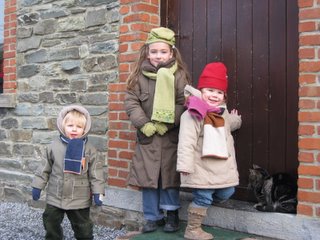
Milo, Minne & Dilara (2005)
Thursday, November 24, 2005
Errata Corrige
I had an enlightment in the middle of the night on something I am truly grateful for, so I'd like to withdraw from my list the #5 item (French sense of humor) and subsitute it with the following:
Number 5: Epideural
Number 5: Epideural
Tuesday, November 15, 2005
The Thrill of Being a Foreigner
On a business trip to Madrid a few years back, I met an old Spanish girlfriend who attended my same graduate school in California, and had, in the meantime, returned to her native Spain.
"You did it again: you’re living abroad!" said Ruth, referring to the fact that I had returned to Europe, but settling in France instead of my native Italy.
There is definitely something thrilling about "being a foreigner." Loads of articles describe the difficulties that expats experience, but I mostly see the thrill and advantages of never being bored by constantly learning new ways to think and doing things, being surrounded by a landscape which is different, and certainly having to speak different languages. Which brings me to...
...The Thrill of Switching Languages
I learnt most of my languages as an adult, therefore this is something I have enjoyed fully and mostly in the last 10 years, in other words, I didn't grow up with it, as Milo will.
I took English in middle and high-school. The teaching methods of the 80’s in Italy were purely theoretical and hardly stimulating: we were submerged by a great deal of grammar rules and British literature (there is nothing exciting about Beowolf when you are 16…) and impractical examples (such as "The pencil is on the table," or "The cat is under the table"), which I never, ever got to use once I become fluent in English! Moreover, the teacher had never stepped foot outside of Italy…my main use of the language at the time was to decrypt the lyrics of Bruce Springsteen!
My first live encounter with the English language took place when I was 18 and I attended a summer volleyball camp in upstate New York. At the camp I got to meet American girls my age who shared my passion for volleyball. The struggle to communicate was immense, especially on the court, but after the 3 weeks spent there, I could finally handle a conversation…I felt powerful! The girls were moved by my accent and often corrected me, sometime made fun of me too… which became a motivator to learn the language properly, finally with a purpose.
During college in the US I took Russian as a foreign language. I loved its sound and the challenge of having to master a different alphabet. I did not go further than a year, unfortunately, but I love renting Russian movies from time to time, and bathe in its sweet musicality.
Iin the US I became friends with several Spaniards and fell in love with Spanish. I took a few courses in a community college, and practiced it during the summer and business trips to Spain. As an Italian native, it is not so difficult, I must admit. I am far from being fluent, but I can get by and understand 80% of what I hear and read.
French is a language I always flirted with; being from the Romance language tree, it is very easy for Italian natives to understand it and pick it up. Furthermore, I am from the Piedmont region, and our dialect has the same roots as French. I bought a grammar book when I was in college and in my spare time I would try to learn it. It wasn’t until I was offered a job in Paris that I applied myself seriously to its sticky grammar traps. But I love to be able to watch French movies in OV and finally have access to its rich literature.
Dutch is a serious challenge: since I met my Flemish companion, I felt obliged to try to learn it, but I was discouraged by the guttural sounds, incomprehensible long words filled with harsh sounds never pronounced before! Since Milo’s birth, however, I hear it every day and I am inevitably picking up a few words and the sentence structure. When I hear my companion speaking on the phone I understand the gist of the conversation and sometimes I decrypt full sentences. Little by little…
I work in an international environment, surrounded mostly by Europeans. Every day I get to speak English, Italian and French at work. At home it’s English with my man, Italian with my son and French with the nanny. It’s only recently that I realized that I was addicted to this, that I consider it a luxury.
Why do I like it so much? Perhaps because each language brings out a different nuance of our soul, it allows my chamaleon personality to play out its game…Each language has its rhythm and pace, its semantic weight and its idiomatic expressions.
There are days when I don’t find my words in any of the three…or, often, when I speak with my man I throw in a word in French and it takes me a while to find the English equivalent. The first days after Milo’s birth we were so overwhelmed that we were mixing everything! I would take Italian worlds and anglicize them…I was a mess!
But in general I think it’s great mental gymnastics and it allows for a wider range of linguistic expression. And, above all, it allows me to reach out to and communicate with a much wider number of people…that’s the real thrill!
"You did it again: you’re living abroad!" said Ruth, referring to the fact that I had returned to Europe, but settling in France instead of my native Italy.
There is definitely something thrilling about "being a foreigner." Loads of articles describe the difficulties that expats experience, but I mostly see the thrill and advantages of never being bored by constantly learning new ways to think and doing things, being surrounded by a landscape which is different, and certainly having to speak different languages. Which brings me to...
...The Thrill of Switching Languages
I learnt most of my languages as an adult, therefore this is something I have enjoyed fully and mostly in the last 10 years, in other words, I didn't grow up with it, as Milo will.
I took English in middle and high-school. The teaching methods of the 80’s in Italy were purely theoretical and hardly stimulating: we were submerged by a great deal of grammar rules and British literature (there is nothing exciting about Beowolf when you are 16…) and impractical examples (such as "The pencil is on the table," or "The cat is under the table"), which I never, ever got to use once I become fluent in English! Moreover, the teacher had never stepped foot outside of Italy…my main use of the language at the time was to decrypt the lyrics of Bruce Springsteen!
My first live encounter with the English language took place when I was 18 and I attended a summer volleyball camp in upstate New York. At the camp I got to meet American girls my age who shared my passion for volleyball. The struggle to communicate was immense, especially on the court, but after the 3 weeks spent there, I could finally handle a conversation…I felt powerful! The girls were moved by my accent and often corrected me, sometime made fun of me too… which became a motivator to learn the language properly, finally with a purpose.
During college in the US I took Russian as a foreign language. I loved its sound and the challenge of having to master a different alphabet. I did not go further than a year, unfortunately, but I love renting Russian movies from time to time, and bathe in its sweet musicality.
Iin the US I became friends with several Spaniards and fell in love with Spanish. I took a few courses in a community college, and practiced it during the summer and business trips to Spain. As an Italian native, it is not so difficult, I must admit. I am far from being fluent, but I can get by and understand 80% of what I hear and read.
French is a language I always flirted with; being from the Romance language tree, it is very easy for Italian natives to understand it and pick it up. Furthermore, I am from the Piedmont region, and our dialect has the same roots as French. I bought a grammar book when I was in college and in my spare time I would try to learn it. It wasn’t until I was offered a job in Paris that I applied myself seriously to its sticky grammar traps. But I love to be able to watch French movies in OV and finally have access to its rich literature.
Dutch is a serious challenge: since I met my Flemish companion, I felt obliged to try to learn it, but I was discouraged by the guttural sounds, incomprehensible long words filled with harsh sounds never pronounced before! Since Milo’s birth, however, I hear it every day and I am inevitably picking up a few words and the sentence structure. When I hear my companion speaking on the phone I understand the gist of the conversation and sometimes I decrypt full sentences. Little by little…
I work in an international environment, surrounded mostly by Europeans. Every day I get to speak English, Italian and French at work. At home it’s English with my man, Italian with my son and French with the nanny. It’s only recently that I realized that I was addicted to this, that I consider it a luxury.
Why do I like it so much? Perhaps because each language brings out a different nuance of our soul, it allows my chamaleon personality to play out its game…Each language has its rhythm and pace, its semantic weight and its idiomatic expressions.
There are days when I don’t find my words in any of the three…or, often, when I speak with my man I throw in a word in French and it takes me a while to find the English equivalent. The first days after Milo’s birth we were so overwhelmed that we were mixing everything! I would take Italian worlds and anglicize them…I was a mess!
But in general I think it’s great mental gymnastics and it allows for a wider range of linguistic expression. And, above all, it allows me to reach out to and communicate with a much wider number of people…that’s the real thrill!
Monday, November 14, 2005
Learning bad words!
Last night a friend from San Francisco who’s in town this week came over for dinner, with her three-year-old son Enzo. He’s the son of a French man and an American woman of Nicaraguan origins. His dad is no longer alive, unfortunately, and so his mum speaks to him in French, while thematernal grand parents speak to him in Spanish. He learns English from school and the environment. At this point he expresses himself primarily in English.
Milo and Enzo hit it off immediately and spent the whole evening running around, playing hide and seek and with the cars, communicating in the international language of play! Until little Enzo decided it was time to show he was a big boy and knew forbidden things: he started pointing randomly at things, shouting proudly:
"Cacca!"
His mum and I, caught by surprise, couldn’t hold back our laughter! It was, unfortunately, the breaching of the dyke.. from that moment on, he knew he got our attention: it was cacca all over the wall!
Milo at first looked puzzled, then rather amused, and decided that it was probably a very cool thing if it had made mum laugh. And so, inevitably, he followed his new friend, shouting all night the new stinky word!
Milo and Enzo hit it off immediately and spent the whole evening running around, playing hide and seek and with the cars, communicating in the international language of play! Until little Enzo decided it was time to show he was a big boy and knew forbidden things: he started pointing randomly at things, shouting proudly:
"Cacca!"
His mum and I, caught by surprise, couldn’t hold back our laughter! It was, unfortunately, the breaching of the dyke.. from that moment on, he knew he got our attention: it was cacca all over the wall!
Milo at first looked puzzled, then rather amused, and decided that it was probably a very cool thing if it had made mum laugh. And so, inevitably, he followed his new friend, shouting all night the new stinky word!
Wednesday, November 02, 2005
Milo’s vocabulary at 18 months
Italian
Mamma
Papá (dad)
Nonno (grandpa)
Nonna (grandma)
Anto (Antoine)
Bibe (milk bottle)
Pappa (food)
Ace, for grazie (thank you)
Nano, for naso (nose)
Pipi
Pupu
Nanna (to sleep)
Tenda (curtain)
Pesce (fish)
Uva (grapes)
Ape (bee)
Bambino (kid)
Ciao Ciao
Vasca (tub)
Doccia (shower)
Etto, for cubetto (little cube)
Pimpa
Mela (apple)
Torta (cake)
Pasta
Si
Barca (boat)
Due (two)
Dutch
Mama
Papa
Water
Bye bye
Op (finished)
Opa
Oma
Auto
Ashblee, for alsjellieft (please)
Apple
Ja (yes)
Noc (again)
Batch, for bard (beard)
Kat (cat)
French
Au revoir
Maman
A boir (to drink)
Nounou (nanny)
Doudou (staffed animal)
Balle (ball)
Bateaux (boat)
Anco (encore)
Dodo (to sleep)
Bebé
Other onomatopoeic sounds:
Mamma
Papá (dad)
Nonno (grandpa)
Nonna (grandma)
Anto (Antoine)
Bibe (milk bottle)
Pappa (food)
Ace, for grazie (thank you)
Nano, for naso (nose)
Pipi
Pupu
Nanna (to sleep)
Tenda (curtain)
Pesce (fish)
Uva (grapes)
Ape (bee)
Bambino (kid)
Ciao Ciao
Vasca (tub)
Doccia (shower)
Etto, for cubetto (little cube)
Pimpa
Mela (apple)
Torta (cake)
Pasta
Si
Barca (boat)
Due (two)
Dutch
Mama
Papa
Water
Bye bye
Op (finished)
Opa
Oma
Auto
Ashblee, for alsjellieft (please)
Apple
Ja (yes)
Noc (again)
Batch, for bard (beard)
Kat (cat)
French
Au revoir
Maman
A boir (to drink)
Nounou (nanny)
Doudou (staffed animal)
Balle (ball)
Bateaux (boat)
Anco (encore)
Dodo (to sleep)
Bebé
Other onomatopoeic sounds:
- PAA-POO-PAA-POO (to indicate the sound of the fire tracks siren)
- BAU (the bark of a dog in Italian)
- MIAO (the cat noise)
- Cucú!
- Tuuu-Tuuuu (train noise)
- NNNNNoooooooooo!
- A-ta-tá (to call his friend Antoine)
- TA-TA (to call his nanny Tamou)
- MMMHWA! (To blow kisses)
- A-bu-bu (?)
- Wroom wroom (make the car noise)
- Peeh Peeh (to imitate the car horn)
- AAAM! (to imitate a lion eating)
- Imitates the rocket ascending in the sky
Friday, October 28, 2005
Which one really are you?
The other day in a rare moment of calm, a pensive Milo looked at me with a profound look and said:
"Mamma….Mama….Mamán ?", pronouncing them perfectly in Italian, Dutch and French.
It was evident that at that moment he was really aware of the three different ways of pronouncing my name, and it was as if he was questioning me whether they really meant the same thing…
"Mamma….Mama….Mamán ?", pronouncing them perfectly in Italian, Dutch and French.
It was evident that at that moment he was really aware of the three different ways of pronouncing my name, and it was as if he was questioning me whether they really meant the same thing…
Wednesday, October 26, 2005
Modern hyperpolyglots
Ever wondered what's the maximum number of languages that an individual can learn and speak? Here's what I found about it:
- Cardinal Giuseppe Mezzofanti (1774-1849), head of the Vatican library, has been known to speak fluently 78 languages and dialects
- Ziad Fazah is the contemporary man who speaks the most languages: he is a Lebanese living in Brazil and speaks 56 languages!
According to Wikipedia, an individual who can speak 6 or more languages is known as a hyperpolyglot! I know at least two of these amazing individuals:
Jan is a 27 years old Flemish manager who seamlessly converses in English, Dutch, German as well as Spanish, Italian and French.
His linguistic odyssey started at age 7 when his parents moved to Spain for professional reasons. Signed up at the local French School, he suddenly had to grasp not one but two foreign languages at the same time. Despite the initial struggles, when he left the country 4 years later, he was fluent in both French and Spanish. His parents had kept on speaking Dutch at home, so coming back to Belgium did not pose too many problems verbally; however, he had some catching up to do in terms of writing skills.
He continued studying French; by the age of 13 he began English classes and by the age of 16 he was also studying German, which he learned quite well motivated by a German girlfriend ("The best method ever!" said Jan).
At 22 while pursuing his university studies he signed up for the Erasmus program and spent 6 months in Siena, Italy. His strong bases in Spanish and French accelerated his command of the language. Trips to the US and the UK also gave him the chance to strenghten his English skills.
He feels very good about his ability to switch from one language to another, both in his personal and professional life. Leaning languages increased his openness to people, cultures and other values, said Jan. It also dissolved any fear of "change" and increased his capability to adapt to any environment. On the other hand, he feels that quantity goes to the detriment of quality: in other words, he feels that sometimes, when fatigued, he finds himself mixing up languages or not finding the right words.
Another wonder of multilingualism is Alain, a French man who discovered at 24 an extraordinary ability to learn languages; today he is fluent in six. The fascinating thing about Alain is that, despite having lived in different countries all is life, he has been in a mostly francophone environment until the age of 8; and yet, French does not feel like the primary language to him, today.
Alain grew up in Picardy until the age of six. His father was in the military and was then transferred to Chad, in Africa, where Alain attended the French school until the age of 8. The family then moved to Baden-Baden, Germany. Here he lived until the age of 16 on the military base, which was a French island in a German environment. He learned German in school, but with great difficulty, having to start from scratch while the other kids lived with at least one German-speaking parent. German has been, therefore, his first foreign language. soon after, he also began studying English.
At 16, he returned to France to finish high-school. He then moved to Saarbrücken, Germany, to begin undergraduate courses, and two years later to Berlin to attend military service. In Berlin, he began fooling around with the Italian language. A three-month stay in Italy to visit a friend sufficed to pick up the language almost fluently.
"I learned tons by watching TV," says Alain.
At that point, at age 24, his passion for languages literally exploded: three months in the US cemented his English; two years in Barcelona made him a great Catalan and Castillan (Spanish) speaker. He then moved to the UK for four years and subsequently to Italy for professional reasons.
"Today I am most at ease when speaking English," says Alain, "but Italian remains the language of sentiments and friendship: I lived some special emotional moments while in Italy, and the language has developed a lot in that sense."
Alain adds that languages need to be polished and trained regularly: "My German is at its most rusty these days, because that is the language I use the least."
He inevitably tickles the interest of his interlocutor, because in each of his six languages, he has an accent or an inflection."Even in French I have an exotic accent!" adds Alain, delighted.
And his accents are not the same in every language:
- In French, he sounds foreign (Belgian, sometimes Swiss)
- In Italian he has a soft French inflection
- In English he has a soft French, but mostly unidentifiable, foreign inflection
- In Spanish he has an Italian accent
- In Catalan he has a French accent
- In German he sounds like he’s "from somewhere in the south"
"I feel more as a European of French origin, rather than a French European; I feel prisoner of a passport which does not really correspond to my cultural identity," said Alain.
Today he lives in London, one of the few cities where he gets to speak all of his French, English, Italian, German, Catalan, Spanish, while studying Portuguese, for fun.
Thursday, October 13, 2005
Science vs. Art: the importance of environmental support
I recently read a great article by Alice Lapuerta on how multilingual mums are often confronted by the narrow view and misconception of monolingual professionals and parents.
When Milo was born, we immediately started pondering how to manage our four languages with him. We consulted several local pediatricians, one of them also a published expert in contemporary pedagogy, hoping to get some guidance and practical advice, backed up by scientific research.
To our dismay, they all discouraged us from multilingualism. They could envisage at most a bilingual household, which meant that in addition to the environmental French, we could choose only one of our languages.
"Which language should we choose, then?" we anxiously asked the expert.
"Just drop the Dutch…I mean…he will learn it later!" he replied randomly.
We were in disbelief! I kept on probing him on the topic, to get at least some scientific explanation to his bizarre 100 EUR advice.
"Madame, la medicine, ce n’est pas une science, c’est un art!" * he replied emphatically.
Professionals with experience in multilingualism are a scarcity in France, where the local culture is so strongly rooted and rich, and where multilingualism has only recently being recognized as an asset. Consequently we contacted some experts in Belgium, but we were especially reassured by expat families and other transnational couples we met in online communities.
When the entourage is not understanding, one can be easily discouraged : for instance, one day at work I was chatting with a Moroccan colleague who speaks Arabic at home, and we were comparing the multilingual skills our kids are developing. Suddenly a French colleague joined the conversation. I asked him innocently if his kids were already studying languages and he replied snappily:
"No, they only speak French…but a very good level of French!"
We soon learned that it's important to develop a certain level of self-assurance when making the choice to bring up multilingual children, and also to know how to find not only the proper support network, but also the opportunities for the children to use these languages outside of the family nucleus.
Luckily in our little entourage, Milo can already count on half a dozen little toddlers who, like him, speak one or two more languages in addition to the local French.
I’d argue that multilingualism as well, is an art!
* "Medicine is not a science, it’s an art!"
When Milo was born, we immediately started pondering how to manage our four languages with him. We consulted several local pediatricians, one of them also a published expert in contemporary pedagogy, hoping to get some guidance and practical advice, backed up by scientific research.
To our dismay, they all discouraged us from multilingualism. They could envisage at most a bilingual household, which meant that in addition to the environmental French, we could choose only one of our languages.
"Which language should we choose, then?" we anxiously asked the expert.
"Just drop the Dutch…I mean…he will learn it later!" he replied randomly.
We were in disbelief! I kept on probing him on the topic, to get at least some scientific explanation to his bizarre 100 EUR advice.
"Madame, la medicine, ce n’est pas une science, c’est un art!" * he replied emphatically.
Professionals with experience in multilingualism are a scarcity in France, where the local culture is so strongly rooted and rich, and where multilingualism has only recently being recognized as an asset. Consequently we contacted some experts in Belgium, but we were especially reassured by expat families and other transnational couples we met in online communities.
When the entourage is not understanding, one can be easily discouraged : for instance, one day at work I was chatting with a Moroccan colleague who speaks Arabic at home, and we were comparing the multilingual skills our kids are developing. Suddenly a French colleague joined the conversation. I asked him innocently if his kids were already studying languages and he replied snappily:
"No, they only speak French…but a very good level of French!"
We soon learned that it's important to develop a certain level of self-assurance when making the choice to bring up multilingual children, and also to know how to find not only the proper support network, but also the opportunities for the children to use these languages outside of the family nucleus.
Luckily in our little entourage, Milo can already count on half a dozen little toddlers who, like him, speak one or two more languages in addition to the local French.
I’d argue that multilingualism as well, is an art!
* "Medicine is not a science, it’s an art!"
Third Culture Kids
This week I finally got an intern at work, I have been waiting anxiously for some help on our increasing anglophone marketing activities. Human Resources phoned me to announce his arrival:
« Pierre-Henri will start on Monday ».
"Pierre Henri" is a distinctly French name, and I had specifically asked for a native English-speaker! It turns out Pierre-Henri had dual citizenship and spoke and wrote impeccable English, even with a thick French accent. His linguistic skills turned out to be as varied as his cultural richness: he is a native of Zaire, who grew up in Japan, Venezuela and recently settled in Paris, where most of his family resides. He speaks Spanish, French, English, Japanese and two local Zaire dialects.
I was about to meet a Third Culture Kid !
Third Culture Kids (or TCKs) are children who grow up or spend a significant part of their childhood living abroad. This definition was coined by the Ruth Hill Useem, professor of sociology at the University of Michigan, who conducted research in the early 90’s on this growing portion of the population.
"Third Culture" refers to the unique culture developed by these individuals who grow up abroad, influenced by their parent’s culture (the "first" culture) and the culture of their host country (the "second" one).
A TCK is usually someone who develops an international outlook. In the article "Strangers in their own land," David Holmestrom writes that in 1998 the US State Department estimated 3.2 million Americans living abroad.
"Kids of these diplomatic, military and corporate parents grow with attitudes and values molded by two or more cultures. In the best of all possible outcomes, TCKs grow up to be the prototype multilingual citizen and ideal worker of the future, sought after professionally as markets and jobs expand globally, " writes Holmestrom.
Professor Ruth Hill Useem came up with some interesting facts about TCKs :
- They are more likely to earn a degree than their peers back home.
- They are often successfully employed in the top ranks of their profession.
- They are more likely to work and live abroad.
- They experience problems when repatriating: their integration is complicated by their world views and by a lack of vital cultural points of reference, such as pop culture icons.
- They are more likely to hit it off with other TCKs, even when they have experienced different countries and cultures.
I do not qualify as a TCK, but I can relate to some of these issues: I grew up in northern Italy, and I moved to the US to pursue my university studies when I was 19. After a few years, I have distinct memories of feeling equally at ease and equally uncomfortable in both my native Italy and in my new host country.
My freshman year in college was a true culture shock. For instance, I had nothing in common with the average American teenager who was trying all sorts of tricks to enter bars illegally and get wasted ! In Italy there’s no drinking age limit, therefore the youth is not focused on breaking down that barrier. And back home, my high school friends were intimidated by my new experiences, so it was best to avoid any recounting of my life in America.
Eventually, with time, I developed un understanding and appreciation for the Amercan way of life and upon graduating from college I had to make a decision: was I going to pursue a career in the US, where I was finally starting to feel at ease, or was I going back home? Where was I to find my home?
It was Petra, my Art History professor, a Dutch historian married to a naturalized Chinese -American, who mentored me in those delicate days. I will never forget when she told me:
"The key is to find something you are passionate about and find a place where you can practice it. It does not matter where: you will always feel at home when you meet people like you and I, those who have had the chance to confront themselves with other cultures and values. You will see, there will be an immediate link."
Over the years, her recipe proved true more than once. I guess that’s also why I am having a great time working with Pierre-Henri!
Tuesday, October 04, 2005
What’s your Family Language Strategy?
In a seafood restaurant in Boulogne-sur-Mer, on a warm September Saturday evening, Milo was attracting the attention of patrons by loudly repeating his new word "fish," both in Italian ("pesce") and Dutch ("vis"), at the request of his mum and Belgian grand-parents.
The owner, a middle-aged French lady, asked me:
"In what language do you speak to him?"
I proceeded to tell her about our quadri-lingual experiment and relative fears and hopes. The lady shared some of it: she was married to an Irish man and had two children, a 7 year-old girl and a 3 year-old boy. They were both born in Ireland, and moved to France when the kids were aged 5 and 1.
Today they speak English at home, as the father does not speak French, but when they were living in Ireland, she tried to speak French as often as possible, to ensure that the kids could learn it [this method is known as the Minority Language (spoken) At Home (a.k.a. mL@H)]. As a result the girl is fluent in both languages and has no accent, she’s a native speaker of both. The boy, on the other hand, understands English perfectly but refuses to speak it, even to his dad. When he does utter some words in English, he speaks it with a thick French accent. For him, French is his one and only mother tongue. The lady has no doubt that, thanks to consistent exposure to English, the boy will eventually start using it, but she feels sorry for the anxiety he experiences using the language.
This case illustrates very well the Family Language Strategy concept, as described by Tracey Tokuhama-Espinosa in her book "Raising Multilingual Children." She claims that a multilingual family should determine its language strategy (i.e. which language will the parents speak at home with the kids) early and stick to it, despite the change in circumstances or environment, for the sake of the children’s consistent language development. Our strategy so far has been the classic "one parent, one language," (a.k.a OPOL).
But I am particularly intrigued by accent development:
The owner, a middle-aged French lady, asked me:
"In what language do you speak to him?"
I proceeded to tell her about our quadri-lingual experiment and relative fears and hopes. The lady shared some of it: she was married to an Irish man and had two children, a 7 year-old girl and a 3 year-old boy. They were both born in Ireland, and moved to France when the kids were aged 5 and 1.
Today they speak English at home, as the father does not speak French, but when they were living in Ireland, she tried to speak French as often as possible, to ensure that the kids could learn it [this method is known as the Minority Language (spoken) At Home (a.k.a. mL@H)]. As a result the girl is fluent in both languages and has no accent, she’s a native speaker of both. The boy, on the other hand, understands English perfectly but refuses to speak it, even to his dad. When he does utter some words in English, he speaks it with a thick French accent. For him, French is his one and only mother tongue. The lady has no doubt that, thanks to consistent exposure to English, the boy will eventually start using it, but she feels sorry for the anxiety he experiences using the language.
This case illustrates very well the Family Language Strategy concept, as described by Tracey Tokuhama-Espinosa in her book "Raising Multilingual Children." She claims that a multilingual family should determine its language strategy (i.e. which language will the parents speak at home with the kids) early and stick to it, despite the change in circumstances or environment, for the sake of the children’s consistent language development. Our strategy so far has been the classic "one parent, one language," (a.k.a OPOL).
But I am particularly intrigued by accent development:
- My Italian friend Francesca, who is married to a French man and lives in Paris, has a 4-year old boy and 2-year old girl. The kids are perfectly bilingual, and when speaking Italian, showcase a French accent.
- My Portuguese colleague Joaquim, married to a Portuguese woman, has two boys, born and raised in France, both perfectly bilingual. They are now learning English and they speak it with a French accent.
What determines these accents in early multilingual kids?
Dr. Steven Weinberger, director of the Linguistics Program and the Speech Accent Archive at George Mason University explained that accents are a natural phenomenon as a result of acquiring a second language after a certain age (approximately age 6). When learning a second language in adult age, the range of sounds we can produce is limited; often the sounds of the second language do not exist in our native language, so our best effort to imitate them, determines the accent.
Professional linguists say that people who start learning a new language after puberty can never completely get rid of traces of their original tongue.
But for kids who are multilingual from birth, their story is different: their language acquisition resides in a different part of the brain, and their attitude to language learning is completely different, less self-conscious, more playful.
So, why would they develop an accent? Stay tuned for the reality behind early accent development, in one of the next entries…
Tuesday, September 06, 2005
The beauty and perils of “Baby Language”
A study carried in 1997 among American, Russian and Swedish mothers showed that the way parents tend to speak to children (that is with acute tones, accentuating vowels, exaggerating the tones) is actually beneficial for the kids' language apprehension, and this is equally true in every language.
This is referred to as Baby Language (or Parentese) in English, Bambinese in Italian and Parler Bebé in French. But in French and in Italian this concept stretches as far as developing a whole new set of made up words, used exclusively with and by kids, which can multiply unnecessarily the vocabulary the kid needs to learn.
Examples:
This is referred to as Baby Language (or Parentese) in English, Bambinese in Italian and Parler Bebé in French. But in French and in Italian this concept stretches as far as developing a whole new set of made up words, used exclusively with and by kids, which can multiply unnecessarily the vocabulary the kid needs to learn.
Examples:
- To take a nap in French baby language is « faire dodó » while in Italian is « fare la nanna »
- To eat in Italian is « mangiare » but for kids becomes « fare la pappa »
- In France almost every kid has a « dou dou » which refers to his favorite stuffed animal.
- In our family we have taken the habit of referring to the bowels as « poo-poo », in Italian that would be « cacca » and in French "caca".
- « Pipi », luckily, is the same in French, English and Italian. But while in English kid language it also refers to the genitals of the boy, the French kids call that « zizi », and in Italy that would be « pisellino » (literally little pea)
- When the kid is hurt, in Italian « si é fatto la bibi », but in French it’s « bobo »
- A kid’s nanny in Italian is often referred to as his « tata », while in France she’s the « nou nou »
Modern pedagogists suggest avoiding this artificial language after the age of 1, even in monolingual households, to facilitate the correct learning of proper vocabulary.
I was going to embrace this theory wholeheartedly, when I realized that the reflex to use these words was just too strong to modify my behavior: I did not realize how embedded certain terms are in our linguistic experiences! I grew up myself eating « pappa » and making « nanna » at night and getting « bibi » from time to time; I still use that expression to let my mum know I’m sick!
Milo for the moment seems to get it all, his favorite word being « Pappa !».
Luckily my little boy is blessed with a vigorous appetite, not only for food, but also for words!
Friday, September 02, 2005
Milo says "Au revoir !"
Milo has just spent 2 weeks in Italy with his grandparents, enjoying a full immersion in Italian. This has increased not only his vocabulary, but also his gestures inventory !
- When eating a delicious food, he accompanies his verbal appreciation ( « Mmmmhhhh ! ») with his hand swinging up and down, at the height of his shoulder !
- He has developed an appreciation for cars (the real ones) and can imitate very well the action of steering the wheel while making the typical car noise (« Wroooooom ! »)
- He waves good bye very professionally when leaving a place or a room, and says « Ciao ! » with non-chalance !
Among new words he learnt there’s « torta » (cake), « bau » (the dog’s bark), « pappa » (food in kid language)
He can call his Nonno (Grandpa) and Nonna (Grandma), his uncle Papo (Paco) and auntie Titti (Kikki), and of course his beloved Mamma and Papaaaaaaá (always pronounced literally)!
Upon our return to France the other day, Milo totally surprised me: as we entered our building, we met the concierge who greeted us (in French); this was the first French he has heard in over 20 days. As we left after a brief chat, he waved good-bye to her and said:
« Au Revoir ! »
At 16 months Milo is aware of who speaks what…
Meet Yannis & Dominique
I was on a flight from Paris to Torino, Italy last week and my seat neighbors were two lovely mulatto rascals aged 6 and 7, traveling with their mum. We begun the conversation in French, language that they were using among one another; as I pointed out to them that we were flying over the Mont Blanc glacier, something in the way I pronounced the word «glacier» gave away my nationality: the two boys looked at each other and instantly switched to perfect Italian:
« Ma é italiana! »* Said Yannis, the youngest.
From that moment on, we continued the conversation in Italian, and even among themselves they kept speaking the tongue of the peninsula. They turned out to have an Italian father while their mum is from French Guyana.
« Nobody knows where the French Guyana is, in Italy! I always have to show them on the map! » said Dominique. It is true, Italians are not strong on French overseas territories…
Their mum woke up shortly after:
«T’a dormi bien, maman ?»** Asked Yannis.
«T’a bien dormi, tu veut dire !» replied their mum, correcting the syntax.
This seems to be a recurrent issue with bilingual kids: they often translate in one language using the syntax of the other. I wonder if this phenomenon has been identified and classified by linguists.
Yannis and Dominique attend the French School in Torino, where most courses are taught in French, but they also learn Italian and some English. However, I noticed that, once they switched language, even with their mum they kept speaking Italian.
Their accent (or, rather, lack of) was that of a native, with a soft inflection of torinese. Even their enthusiasm was that of an Italian boy when they noticed that we were flying over a soccer field! They immediately told me about their favorite team and players in the Italian league.
Before leaving the baggage claim, Dominique sighed:
«I cannot wait to see my room again and sleep in my own bed…I miss my bed!»
Something common to every culture: the notion of 'home sweet home!'
* «But she is Italian!»
** The equivalent phrase in Italian is: "Hai dormito bene?". It would be as if he asked:
«Did you well sleep, mum ?» instead of « Did you sleep well ?»
« Ma é italiana! »* Said Yannis, the youngest.
From that moment on, we continued the conversation in Italian, and even among themselves they kept speaking the tongue of the peninsula. They turned out to have an Italian father while their mum is from French Guyana.
« Nobody knows where the French Guyana is, in Italy! I always have to show them on the map! » said Dominique. It is true, Italians are not strong on French overseas territories…
Their mum woke up shortly after:
«T’a dormi bien, maman ?»** Asked Yannis.
«T’a bien dormi, tu veut dire !» replied their mum, correcting the syntax.
This seems to be a recurrent issue with bilingual kids: they often translate in one language using the syntax of the other. I wonder if this phenomenon has been identified and classified by linguists.
Yannis and Dominique attend the French School in Torino, where most courses are taught in French, but they also learn Italian and some English. However, I noticed that, once they switched language, even with their mum they kept speaking Italian.
Their accent (or, rather, lack of) was that of a native, with a soft inflection of torinese. Even their enthusiasm was that of an Italian boy when they noticed that we were flying over a soccer field! They immediately told me about their favorite team and players in the Italian league.
Before leaving the baggage claim, Dominique sighed:
«I cannot wait to see my room again and sleep in my own bed…I miss my bed!»
Something common to every culture: the notion of 'home sweet home!'
* «But she is Italian!»
** The equivalent phrase in Italian is: "Hai dormito bene?". It would be as if he asked:
«Did you well sleep, mum ?» instead of « Did you sleep well ?»
Subscribe to:
Posts (Atom)